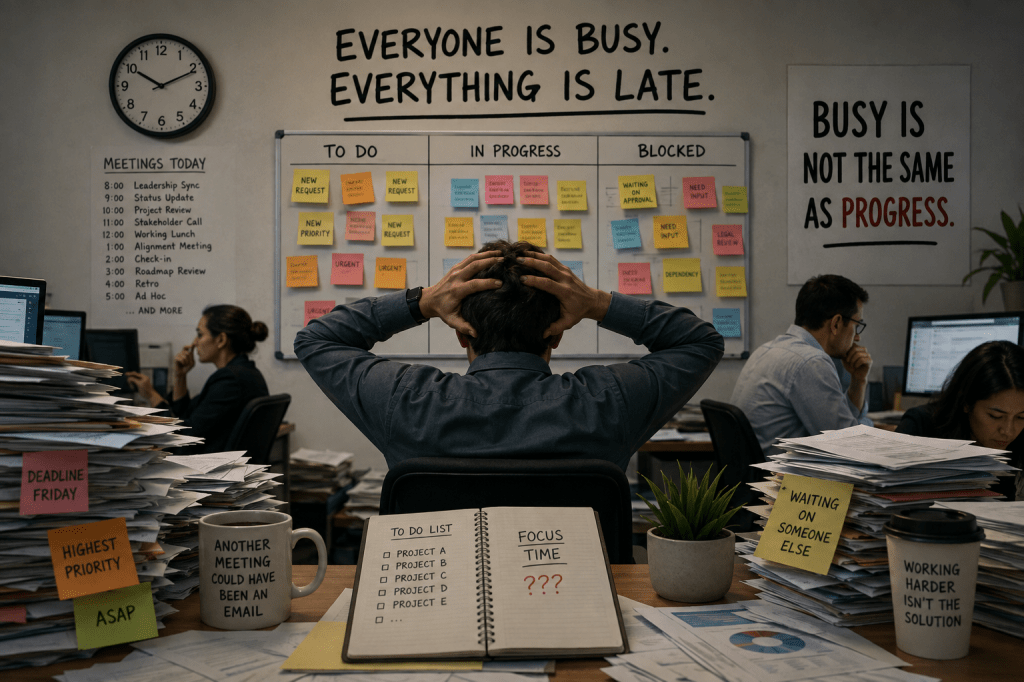
Every team lead has lived some version of this. People are working long hours. Calendars are wall-to-wall meetings. Everyone seems busy. Yet deadlines keep slipping, leadership is unhappy with the output, managers insist they don’t have enough talent, and the people doing the work are quietly burning out.
The instinctive response is predictable: hire more people, push harder on deadlines, replace the supposed underperformers.
Sometimes there really is a talent problem, and no amount of process fixing will substitute for it. But often something else is happening. The organization has confused how busy people are with how much work is actually getting finished. A team can be operating at full capacity while the work itself is barely moving.
Busy Is Easy to See
Organizations are remarkably good at measuring activity. We see full calendars, count how many projects someone owns, track utilization, hours, tickets, deliverables. When everyone is stretched, it feels like the organization must be extracting maximum productivity from its people.
But activity isn’t flow. Flow is the rate at which work actually moves from start to finish, as opposed to how occupied people look while it’s in motion.
Take a team of ten working on three important projects, and hand them twelve instead. Everyone immediately gets busier: more meetings, more status updates, more dependencies, more deadlines. Nobody looks underutilized. But each project now spends more time waiting for someone’s attention. People switch constantly between tasks. Decisions queue up. Work gets started faster than it gets finished.
Individual utilization can rise even as organizational throughput falls. That’s the paradox: everyone can be individually busy while the organization is collectively slow.
Measure the Work, Not Just the People
When a team keeps missing deadlines, three questions matter more than any hours dashboard.
How much work is in progress? How many “important” projects is each person carrying? How much new work enters the system each month versus how much actually gets completed? A team that starts ten things and finishes six hasn’t created capacity. It’s created four more unfinished projects competing for attention.
How quickly does work actually move? Look past hours worked. How much of the week is focused work versus meetings, status updates, and coordination? Pull real calendar data. Check how many recurring meetings actually produce a decision. The goal isn’t to kill collaboration. It’s to understand why a team logging fifty hours can produce surprisingly few hours of real concentration.
How much time does work spend waiting? This is the least visible constraint of all. How many approvals does routine work require? How often is someone blocked waiting on another team or manager to decide? A task can take ten hours of actual effort and three weeks waiting for permission to proceed. From outside, the team looks slow. The real constraint is decision latency, not effort.
Work in progress, flow, and waiting time tell you far more than a busy calendar ever will.
There’s a fourth thing worth checking, not a question this time but a design choice organizations make without noticing: how much spare capacity the system is allowed to carry.
Why 100% Utilization Backfires
Most managers instinctively dislike unused capacity. If someone has room in their schedule, surely there’s another project for them. So organizations keep filling the space.
But systems running near maximum capacity become extremely sensitive to variability. One unexpected fire, whether it’s a customer escalation, a resignation, or a technical failure, pushes everything else behind because there’s no shock absorber left.
Visible slack isn’t waste. It’s often what lets a system keep moving when reality deviates from the plan.
But slack is politically hard to defend because busyness is visible and resilience isn’t. A packed calendar looks productive. Someone with room to think looks underutilized.
So we optimize for what we can see, and eventually everyone is busy.
How System Problems Get Mistaken for Talent Problems
This is where diagnosis usually goes wrong. A team misses deadlines, so leadership concludes it needs stronger people.
Sometimes that’s right. But before accepting it, ask one question:
If the team’s total workload were cut by a third, would the talent gap still be obvious?
If yes, there’s probably a real skills problem. That’s the signal worth hiring against: a specific capability the team genuinely lacks, still visible once the noise of overload is removed.
If no, capable people may simply have been operating inside a badly overloaded system. Someone juggling six priorities can’t go deep on any of them. A manager spending thirty hours a week in meetings has little time left to actually manage.
Under those conditions, system failure looks a lot like individual underperformance. And adding more people doesn’t necessarily help. More people can simply mean more coordination, more meetings, and more dependencies unless the operating model itself changes.
What Leaders Can Actually Change
Reduce work in progress. Give teams a real top three, not a top ten disguised as one. When something new becomes urgent, force an explicit decision about what drops.
Protect flow. Remove recurring meetings that don’t produce decisions or move work forward. Protect uninterrupted time, and don’t consume synchronous capacity when asynchronous communication will do.
Attack waiting time. Push routine decisions closer to the people doing the work. Approval should scale with risk, not hierarchy.
Stop planning at theoretical maximum capacity. Leave room for the unexpected. It isn’t an exception. It’s part of operating reality.
Change what gets celebrated. If the person emailing at midnight gets more recognition than the one who reliably delivers during normal hours, the culture has already told everyone what it actually values. Leaders can’t preach sustainable performance while rewarding visible exhaustion.
The Real Productivity Problem
Burnout, missed deadlines, and complaints about talent often look like three separate problems. They’re usually three symptoms of the same operating system: too much work enters, too little exits, and everything in between competes for the same finite attention.
The overloaded organization’s instinct is to demand more effort. But when everyone is already busy, effort was never the missing ingredient.
The job isn’t to maximize how busy people look. It’s to maximize how reliably important work gets finished.
Sometimes the fastest organization is the one willing to leave some capacity unused.


Vijay,
We agree, but you missed the biggest problem when everyone is 100% busy. People, your employees, stop thinking. They just do.
They miss opportunities. There is no AHA moment. They can’t try something new, so they just pound it out the old way through copy and paste. Worse, they use GenAI to answer the question without any understanding, ask for code, string together a few sentences, and tell GenAI to complete work and then push it out as if this productivity. It just makes someone else responsible for clean-up downstream.
Busy is just the new KLOC.
-Chuck
LikeLike