The prevailing narrative in tech assumes AI is making software engineers dramatically more productive. That may hold true if you only measure code generation, but it falls apart when you look at software delivery. We are confusing the speed of typing code with actual system velocity.
For commodity, CRUD-heavy work where “good enough” truly suffices, AI genuinely collapses the friction of basic implementation. But in high-stakes domains—where failure affects security, financial integrity, or systemic stability—writing code was never the primary constraint. Technology rarely eliminates structural constraints; it simply migrates them. Make one layer of a system cheap and abundant, and scarcity shifts elsewhere. Today, the marginal cost of generating implementation code is collapsing, making it vastly cheaper to produce than to understand, integrate, and validate.
The bottleneck hasn’t been solved. It has just moved downstream.
The Migration of Scarcity
In the pre-AI era, the primary friction in software development was translation: converting business domain requirements into syntactically correct, performant code. Today, LLMs can generate large blocks of implementation in seconds. But shipping software was never just about raw typing speed. It is about integration, state management, security boundaries, and operational coherence.
When generation capacity increases dramatically, existing review and testing processes that worked fine at lower volumes inevitably come under pressure. Pull request queues fill up, integration testing becomes noisier, and regression surfaces expand dramatically. More generated code creates vastly more state space to test, secure, and operate.
This isn’t an anti-AI argument; it is a systems argument. Calling review queues “just a process problem” misses the fundamental scale shift. When generation velocity outpaces an organization’s capacity to verify and safely deploy what was produced, you haven’t accelerated delivery. You’ve simply created a high-speed traffic jam downstream.
Slop Debt and the Comprehension Gap
We all know what classic technical debt looks like: messy abstractions, missing tests, and hardcoded logic written under deadline pressure. It’s ugly, but it is visible, accumulated over time through conscious trade-offs, and familiar to refactor.
The AI era introduces a far more deceptive challenge: Slop Debt. Slop debt isn’t simply bad or unreadable code; it is code generated instantly at scale whose production cost has collapsed while its comprehension and verification costs have not.
AI-generated code often looks immaculate. It passes linting, features clean syntax, and arrives with unit tests attached. But slop debt is dangerous precisely because it is invisible—it satisfies basic automated checks while embedding subtle semantic errors or invariant violations that only emerge under operational pressure.
Even when the output is well-structured, generation scales dramatically faster than human comprehension. An agent can produce thousands of lines of implementation in minutes, but an organization still requires human judgment, domain context, and operational experience to verify that those lines correctly represent business invariants.
One of the most dangerous codebases in 2026 may be the pristine, AI-generated system that no human on the team actually understands well enough to debug when it fails in production. When generation is cheap, comprehension becomes the scarce asset.
Judgment as the Competitive Moat
Recognizing this shift is not about protecting titles or gatekeeping junior developers; it is a question of cognitive capacity and epistemology. AI separates implementation fluency from architectural judgment.
For years, early-career engineers built leverage through syntax mastery and framework fluency. AI rapidly commoditizes that layer. But a senior engineer’s value was never how fast they could write a loop; it was their cynical, battle-tested intuition for race conditions, edge cases, and failure domains. An engineer who has not yet internalized these failure modes cannot recognize them in an agent’s output, regardless of prompt quality.
If junior engineers rely on AI before mastering core fundamentals, they risk becoming human rubber stamps for a probabilistic model—unable to audit what they do not understand. Conversely, senior judgment becomes dramatically more valuable when paired with abundant generation. Experienced engineers can immediately evaluate whether a generated block strengthens the system or introduces subtle, systemic fragility.
The competitive moat is no longer typing speed or syntax recall. It is the judgment required to know whether a model’s output should exist in production at all.
From Drivers to Governors
If your mental model of AI is still pasting prompts into a chat window and copying code back into an IDE, you are looking at an outdated workflow. The unit of AI-assisted engineering has moved from the isolated prompt to the end-to-end workflow.
Modern coding agents don’t just autocomplete functions. They inspect repository trees, modify multi-file architectures, execute test suites, catch runtime errors, and submit structured pull requests. As these agents operate asynchronously, the engineer’s role shifts from driver to orchestrator. You are no longer primarily producing raw code; you are governing a production system—establishing the boundary conditions, safety policies, and control surfaces under which autonomous agents run.
Embedding probabilistic models and agentic loops into backend architectures introduces semantic non-determinism—not the familiar timing jitter of distributed networks, but uncertainty at the level of meaning and execution logic. Traditional systems handle latency; probabilistic agents can change what a system does, not just when it does it.
Verification can no longer mean checking whether code compiles or passes a unit test. It requires building deterministic guardrails around probabilistic engines to handle variable latency, schema drift, tool-selection errors, and cascading failure states.
The Recursive Scarcity Chain
When human verification becomes the bottleneck in an era of abundant code, the verification function itself must be industrialized and automated. The future lies in building AI-driven verification systems—agents that generate formal specifications, run adversarial simulations, execute invariant checks, and enforce dynamic guardrails.
Automating verification doesn’t create an infinite regress. It simply moves the constraint to a higher level. The question becomes: Who verifies the verifier?
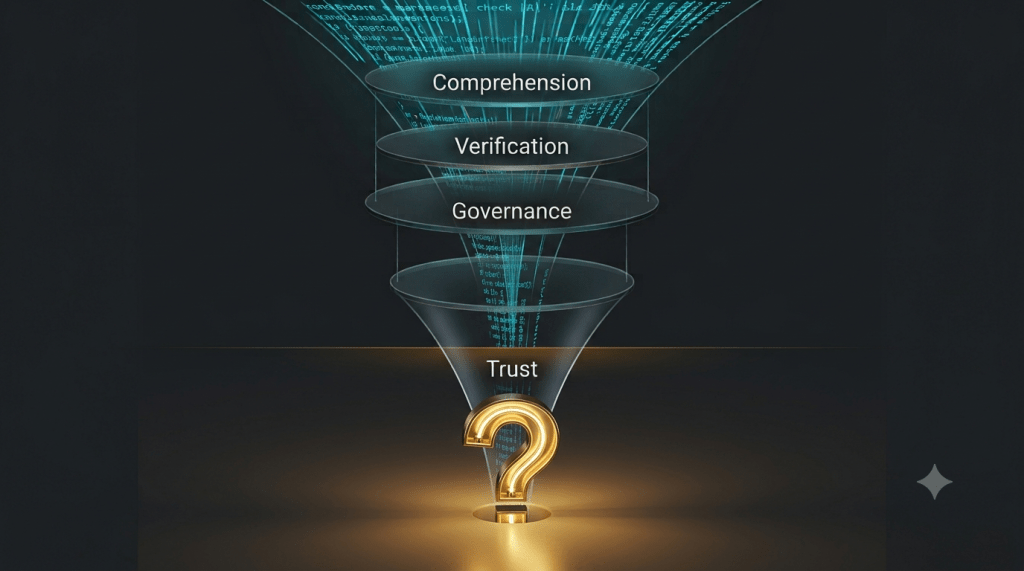
The evolution of the engineering stack is not a linear waterfall pipeline, but a recursive shift in binding constraints. As technology automates or commoditizes one layer, value and friction migrate downstream. Looking at this migration shows where economic leverage is concentrating today:

Generation. Writing implementation code drops from a manual bottleneck to a collapsing marginal cost.
Comprehension. As syntax and framework boilerplate get absorbed by agents, value shifts to system comprehension and deep domain context.
Verification. As routine validation gets automated, test adequacy, invariant design, and knowing what must be verified become the new scarcity.
Governance. Automated verification systems handle routine checks, elevating architecture, boundary setting, and policy enforcement into the primary control surfaces.
Trust. As agentic workflows manage generation and verification, economic value increasingly centers on establishing system-level trust.
When implementation becomes cheap, the premium shifts increasingly toward comprehension, verification, architectural judgment, and system accountability. The defining question of this era is no longer “How fast can we build this?” but “What happens when it fails—and can we prove it is safe to trust?”
The most valuable engineers of the AI era won’t be the ones who generate the most code. They will be the ones who build the architectures and control systems that determine when AI should be trusted, when it should be constrained, and when it should be rejected.

