The Functional Enterprise


What Survives When Expertise Becomes Free

AI is making expertise abundant, but modern corporations were built around the opposite assumption: that expertise was scarce and had to be concentrated. That assumption shaped the modern company because every major technology revolution changes more than the tools people use. It changes the way organizations decide, coordinate, and create value.

The Industrial Revolution did not just create factories. It created a management system for coordinating thousands of workers and machines, and hierarchy emerged because industrial scale required a new way of organizing people, processes, and decisions. As companies became larger and more complex, a different constraint emerged. The problem was no longer simply coordinating labor, but finding, distributing, and applying specialized knowledge. The answer was the functional enterprise: Sales, Finance, Marketing, HR, Legal, and Technology.

These departments feel like permanent features of business today, but they were historical responses to a specific problem. Expertise was difficult to create and even harder to distribute, so companies built functions around where specialized knowledge lived. The org chart reflected where the brains were parked. Financial expertise lived in Finance, customer understanding in Marketing, technical expertise in Technology, and legal judgment in Legal.

For more than a century, this architecture worked because expertise, authority, and accountability were bundled together. The people producing the analysis were usually the people trusted to exercise judgment.

AI breaks that relationship.

For the first time, expert-level analysis can be generated outside the functions that historically owned it. A product manager can evaluate financial scenarios, a salesperson can build sophisticated proposals, and an operations leader can diagnose complex problems without assembling a room full of specialists.

The important shift is not that expertise disappears. It is that expertise is no longer confined to the place where the organization expects to find it.

This creates a new management problem. When everyone can generate expert-level analysis, the production of expertise is no longer the scarce resource. Judgment is. Anyone can manufacture an answer. The harder question is deciding which answers deserve to be trusted.

This is where much of the AI conversation stops too early. The question is not whether machines can produce answers. It is how organizations preserve judgment when the production of insight is no longer limited to the experts who historically controlled it.

That challenge extends beyond today’s organization. It also raises a question about tomorrow’s leaders. For generations, institutional judgment was built through the manual work of junior professionals: building spreadsheets, reviewing contracts, writing code, and learning from mistakes. If AI increasingly performs the production of analysis, the traditional apprenticeship model that produced future CFOs, General Counsels, and CTOs begins to disappear. How organizations develop judgment in an era where fewer people learn by doing may become one of the defining management questions of the AI age. It deserves a deeper discussion than this post allows, and I’ll return to it in a future post.

Furthermore, while the generation of analysis can be decentralized, legal liability and regulatory accountability cannot. A product manager might run an autonomous financial scenario, but the CFO still signs the Sarbanes-Oxley certification. A salesperson might use an agent to draft a contract, but the General Counsel still carries the ultimate fiduciary responsibility.

Functions were never valuable simply because they produced analysis. They mattered because they created trusted places where judgment could live, and where ultimate accountability could be held. Finance was never valuable because spreadsheets were difficult to create. It was valuable because someone had to decide where capital should go. Legal was never valuable because contracts were hard to review. It was valuable because someone had to decide which risks the company was willing to accept. Technology was never valuable because writing software was impossible. It was valuable because someone had to decide which systems could safely run the business.

AI does not remove those responsibilities. It changes where the value sits.

The risk is that functions confuse authority with judgment, retaining approval rights while gradually losing the deep understanding required to make good decisions. Faced with that shift, the natural instinct will be to defend traditional boundaries, budgets, and approval rights. That response protects the function, but it does not strengthen the enterprise. It simply turns the function into a bottleneck.

A Finance organization that simply approves AI-generated analysis becomes a rubber stamp. A Legal organization that blindly accepts AI-generated contracts becomes a risk multiplier. A Technology organization that governs intelligent systems without understanding how they fail becomes a governance layer without technical depth.

The functions that matter in the future will not be the ones that produce every answer, nor will they be the ones that use policy to slow execution. They will be the ones that stay closest to where judgment fails.

The answer to the trust question is not the function with the most authority. It is the function with the strongest understanding of the consequences when judgment fails. That understanding cannot be preserved through approval rights alone. It comes from staying close to failure.

Crucially, this failure is rarely a single catastrophic event. In an AI-driven enterprise, the greater threat is silent drift: the slow, almost invisible erosion of quality across thousands of automated micro-decisions.

Preventing that drift requires an active connection to reality. A Finance team maintains its judgment by understanding why forecasts miss. A Legal team maintains its judgment by studying where automated reviews overlooked nuance rather than waiting until a public dispute exposes the gap. A Technology team maintains its judgment by understanding how intelligent systems behave under real-world conditions rather than controlled demonstrations.

The old enterprise was designed to move expertise. Work flowed from Sales to Operations, from Operations to Finance, and from Finance to Legal because knowledge lived inside the function. That logic begins to break down once expertise becomes widely available. The challenge is no longer moving work to where the knowledge sits. It is making sure the organization learns faster than the complexity it creates.

That requires a different operating rhythm. Finance cannot wait for the annual planning cycle to discover whether its assumptions were wrong. Legal cannot learn only after litigation exposes weaknesses in contract review. Every function has to shorten the distance between prediction and outcome, not because every consequence arrives quickly, but because an organization that learns slowly ends up governing tomorrow’s decisions with yesterday’s assumptions.

This is why functions will not disappear. They will become more important, but for a different reason.

For more than a century, companies organized themselves around where expertise lived. The next generation of companies will organize themselves around where judgment is created, challenged, and continuously refined.

That is a different kind of institution.

Most executives think they are introducing AI into a twentieth-century corporation.

They are discovering that the corporation itself is the legacy system.
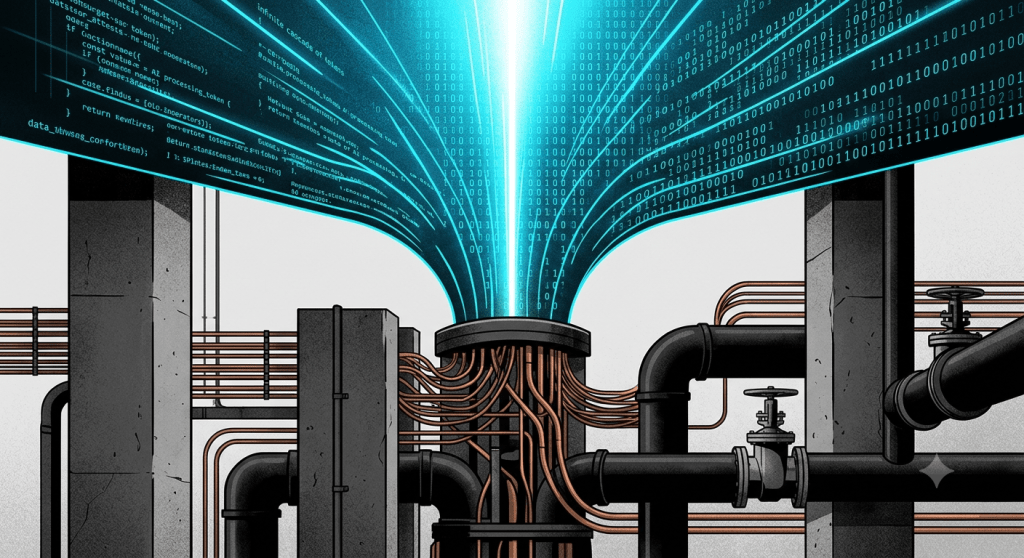
The Shortage in the Surge


Every technological revolution creates abundance. Every economic revolution begins with a shortage.

This is the central paradox of progress. When a technological breakthrough occurs, our instinct is to gaze directly into the light of the explosion. We celebrate the elimination of a historic limitation. We conclude that the world has changed because what was once expensive and difficult has become cheap and ubiquitous.

But abundance does not automatically generate economic value. It frequently destroys it.

When a breakthrough makes a previously scarce resource abundant, the price of that resource collapses toward its marginal cost of production. Persistent economic rents do not pool in the sea of abundance. They accumulate around scarce constraints.

Every technological revolution creates two simultaneous stories. The first is the story of abundance. It dominates public attention because breakthroughs are highly visible. The second is the story of migration. It determines where enduring economic value accumulates because constraints are less visible.

The true economic revolution begins only when we look away from the breakthrough and start looking for the new shortage it has created. Technology does not eliminate constraints. It changes the architecture of constraints.

I. The Engine of Friction

To understand why this cycle repeats, we have to look at the foundational physics of operations. In his 1984 classic The Goal, Eliyahu Goldratt codified the Theory of Constraints, proving that any complex system has exactly one bottleneck that dictates its total throughput. What was true for twentieth-century manufacturing plants is now scaling exponentially across twenty-first-century digital ecosystems. Technology doesn’t eliminate Goldratt’s law. It simply accelerates the speed at which the bottleneck moves.

No business, industry, or economy is a single machine. It is a chain of connected steps operating at different speeds. Because the throughput of the entire chain is determined by the slowest necessary link, every system always has a limiting factor.

Eliminate one bottleneck, and the pressure instantly shifts to the next one. A constraint is not a glitch or a temporary market failure. It is the unavoidable reality of any interconnected operation.

At any given moment, the speed of an entire industry is dictated by this single element: the binding constraint. It is the anchor that determines the capability, speed, and profit margins of an era.

Historically, we have defined our major industrial shifts by the nature of these anchors. For centuries, the binding constraint of human productivity was raw muscle power. Then came steam and electrification, which made energy cheap and abundant. Suddenly, the bottleneck was no longer the ability to generate force, but the ability to coordinate parts. The binding constraint shifted from power to the physical layout of the factory floor.

More recently, we spent decades constrained by the speed and cost of moving data. Digital networks made distribution abundant and essentially free. The moment information became abundant, the binding constraint migrated to human attention and synthesis.

The illusion of the breakthrough is believing that solving the old constraint is the end of the journey. In reality, it is merely the opening of a new theater of scarcity.

II. The Factory Floor Reality

Consider a simple assembly line. If a factory has three stations—Station A produces 100 units an hour, Station B produces 10 units an hour, and Station C processes 50 units an hour—the total output of the factory is exactly 10 units an hour. Station B is the binding constraint.

Now imagine an inventor arrives with a miraculous machine that allows Station A to produce 1,000 units an hour. The temptation is to celebrate the infinite capacity of Station A. Investors pour capital into optimizing it even further.

But what is the actual output of the factory?

It remains exactly 10 units an hour.

In fact, making Station A ten times faster creates a crisis. Inventory piles up in front of Station B. The system becomes choked, chaotic, and inefficient. The abundance at Station A has not solved the factory’s problem. It has magnified the shortage at Station B.

An optimization made anywhere other than the bottleneck is an illusion.

When a technological revolution introduces radical abundance into an environment, it behaves exactly like that miraculous machine at Station A. It accelerates one part of the system to near-infinite speed. In doing so, it exposes the structural friction, institutional inertia, and physical limitations everywhere else. The binding constraint moves, and it moves with brutal clarity.

III. The Token Paradox

We are watching this exact pattern unfold at the software layer of the AI race. Over a remarkably brief window, architectural breakthroughs, open-source competition, and intense model distillation have cratered the cost of base intelligence. Based on published frontier-model API pricing benchmarks, the cost of standard foundation capabilities has collapsed from an early 2023 baseline of roughly $20 per million tokens down to fractions of a cent on modern value-tier endpoints. Raw text generation and basic reasoning have entered the sea of abundance, racing toward their marginal cost of production.

Yet, as the unit price of intelligence drops, enterprise AI budgets are expanding rather than contracting. This is not a contradiction; it is a volume explosion driven by a fundamental shift in architecture. As organizations move past single-turn chat interfaces, they are deploying autonomous, agentic workflows that consume millions of tokens to execute complex business processes.

According to the Menlo Ventures 2025 Enterprise GenAI Report, enterprise generative AI spend surged 3.2x over a single twelve-month cycle, climbing from $11.5 billion to $37 billion. This massive deployment of capital is scaling off an entirely new baseline budget. Longitudinal tracking from Andreessen Horowitz’s Enterprise AI Buyer Surveys across sequential waves charts this compounding expansion clearly: an initial survey wave recorded an expected 75% growth in GenAI budgets, which has since transitioned into an additional 65% year-over-year projected increase as average corporate allocations scaled up from $4.5 million to $7 million per enterprise.

Crucially, the massive influx of capital has completely altered how corporate buyers approach the technology stack. In 2024, corporate adoption was split roughly down the middle between building internal custom scaffolding and purchasing external platforms. Today, Menlo Ventures data reveals that 76% of enterprise AI use cases are purchased rather than built in-house.

Enterprises are shifting away from internal builds because cheap intelligence has not eliminated the enterprise bottleneck. It has exposed a new one, moving the binding constraint from intelligence generation to verification and trust. As I argued recently in The End of the Model Bet, an enterprise strategy built primarily on access to increasingly commoditized foundation tiers is becoming progressively less durable.

When an agent can generate thousands of lines of code or process exhaustive corporate document queues for pennies, the scarce resource is no longer raw output. It is confidence. Enterprises need deep structural ways to prove that AI-generated actions will not break production systems, violate regulations, leak sensitive data, or confidently fabricate errors.

Consequently, economic value is migrating rapidly away from the commoditized model layer toward enterprise orchestration, data governance, evaluation, and deep verification systems. The new scarcity is certainty.

IV. The Infrastructure Wall

The same mechanism is simultaneously reshaping the physical layer of AI.

For years, the strategic bottleneck was a shortage of advanced silicon. Capital rushed to solve it, and technology companies committed hundreds of billions of dollars to expanding compute capacity.

As compute capacity grows, the next binding constraints are increasingly power availability, grid interconnection, cooling, and data center capacity. The abundance of compute has not eliminated the scaling problem. It has transferred the pressure to the physical infrastructure required to operate that compute.

We are already seeing market capital follow those constraints. Investment is surging toward firm energy infrastructure, on-site power generation, grid upgrades, and specialized cooling technologies.

Crucially, the primary constraint here is no longer a lack of capital or interest—it is the grinding reality of institutional and physical queues. Data compiled by the Lawrence Berkeley National Laboratory (LBNL) Interconnection Queues Tracking reveals that the U.S. transmission queue remains historically gridlocked at over 2,000 gigawatts of active capacity. While a massive wave of unviable, speculative projects withdrew after facing escalating study costs, the viable infrastructure projects that remain face a median duration approaching five years to move from initial request to full commercial operation. The bottleneck has entirely shifted from the factory producing chips to the infrastructure clearing the grid.

This dynamic follows the historical script of industrial scaling. The shipping container made transoceanic transport radically cheaper, faster, and more predictable. The binding constraint shifted away from loading cargo onto ships and toward port infrastructure, logistics coordination, and warehouse networks. Over time, ocean freight became increasingly commoditized while value accumulated around the new constraints.

When value migrates, incumbents often fall into a capital allocation trap. They continue investing in yesterday’s advantage long after the market has stopped assigning it a premium. They mistake growing output for enduring value.

V. The Strategic Diagnostic: Mapping the Next Scarcity

For leaders building agentic enterprises, this framework is more than an explanatory lens. It must function as an active capital allocation tool. When designing an automation roadmap, leaders must subject every technical deployment to a rigorous three-step constraint audit:

  1. What scarcity are we eliminating? Which historically expensive or slow capability is about to become abundant and practically free? (e.g., massive-scale financial invoice reconciliation, customer inquiry triage, or rapid application code generation).
  2. Where does the bottleneck move next? Once that capability becomes effectively unlimited, where will work begin to queue instead? If an autonomous system can process 50,000 complex validation events an hour instead of 5, the new constraint is no longer production speed—it is the exception-handling capacity of human operators or the automated multi-party dispute verification engines required to act safely on those outputs.
  3. Are we investing in the new constraint? Stop over-investing in the dissolved anchor. Shift enterprise budgets away from basic model access and redirect capital toward building the proprietary workflows, guardrails, and automated validation layers surrounding the secondary bottleneck.

If you optimize the system anywhere other than the newly exposed constraint, you are wasting capital to build an inventory pile-up.

VI. The Cost of Adaptation Lag

Why is this reality so difficult for leaders to act upon?

Because technology scales exponentially while institutions scale linearly. A technological breakthrough can happen within a year. Reorganizing companies, incentives, regulations, talent, and operating models to absorb that breakthrough can take a decade.

That gap is adaptation lag.

During this period, organizations use new technology to execute old processes. They bolt AI onto legacy workflows. They use a jet engine to pull a covered wagon.

Changing technology is relatively easy. Changing institutions is extraordinarily difficult. It requires redesigning incentives, operating models, governance, skills, and organizational architecture. This is closely related to the core premise of The Last Proprietary Advantage: as transient technical advantages erode, enduring corporate differentiation shifts entirely toward how organizations are wired to execute.

As a result, the binding constraint eventually ceases to be technical. It becomes institutional. The shortage is no longer capability; it is institutional capacity to absorb abundance safely and effectively.

The Core Synthesis

The central insight is simple. Technological breakthroughs systematically reconfigure the architecture of constraints. Because capital and institutions adapt more slowly than technology, enduring economic advantage migrates toward the newly binding constraints.

You do not need to predict the precise technical specifications of the next breakthrough to understand where value will emerge. You only need to identify today’s binding constraint, understand what abundance is about to dissolve it, and ask where the pressure will move next.

Every technological revolution begins by answering one question.

Not: What became abundant?

But: What became scarce because of that abundance?

Every generation mistakes the breakthrough for the destination. It never is. The breakthrough simply changes where scarcity lives.

The companies that keep investing in yesterday’s scarcity become yesterday’s winners. The companies that discover tomorrow’s scarcity build the next era.

That is where enduring advantage will be found.

The Capital Allocation Trap


Every major technology wave begins by optimizing the wrong bottleneck.

Computing made calculation abundant. We built software. Bandwidth made communication abundant. We built platforms. AI made the production of intelligence abundant. So we optimized for models.

Alas, that was the wrong bottleneck. AI does not just create an automation revolution. It exposes the limits of deployment.

The last two years of AI investment have been built around a simple assumption: the company with the most powerful intelligence layer will capture the most value.

Capital flowed into model training, GPU clusters, and larger inference systems because the industry believed intelligence itself was the scarce resource.

Every technology wave eventually hits the same wall. Making something abundant is easy. Rebuilding the world around that abundance is the hard part.

AI has just about reached that point.

The bottleneck is moving from creating intelligence to deploying it. That sounds like a subtle distinction. It isn’t. It is where trillions of dollars of value will be won or lost.

The Intelligence Illusion

The industry has confused the cost of producing intelligence with the cost of putting intelligence to work.

The marginal cost of producing intelligence is collapsing. Models are improving. Training techniques are spreading. Inference is becoming cheaper. Capabilities that once required billions of dollars of research are increasingly available to anyone with enough compute.

But deployment has a different physics.

A model can be copied instantly. A data center cannot. A software capability can scale globally overnight. A power grid cannot. An AI agent can be created in seconds. The semiconductor supply chain required to run millions of agents takes years to expand.

The digital layer moves faster than the physical layer beneath it. Software creates demand before the world has built the capacity to satisfy it.

You cannot prompt your way around a power shortage. You cannot fine-tune your way around a data center that does not exist.

For the last decade, software convinced us that technology had escaped physical constraints. AI is reminding us that software still runs on a physical world.

The evidence is already visible. In 2024, Microsoft signed a 20-year agreement with Constellation Energy to purchase the entire output of the restarted Three Mile Island Unit 1 nuclear facility.

It was a power purchase agreement. It was also an admission that reliable energy had become a strategic input to AI.

When the world’s largest software companies start signing twenty-year power contracts, it is a signal that the bottleneck has moved. The competition is no longer only about who builds the best model. It is about who can secure the infrastructure required to make those models useful.

But physical capacity is only half the problem.The other half is institutional capacity !

A company can have access to world-class models and abundant compute and still fail to create value.

Why?

Because enterprises are not blank sheets of paper. They are decades of processes, systems, regulations, incentives, and decision-making structures.

A global bank does not fail to deploy AI because the model does not exist. It fails because the model must operate inside systems built over decades. It must satisfy model risk requirements, maintain audit trails, produce explainable decisions, integrate with legacy platforms, and fit into governance structures designed for deterministic software.

The reality of the enterprise is that agility is not a software problem. It is a cultural and architectural inheritance.

You cannot deploy an autonomous agent into a workflow where the humans involved do not know how to trust a probabilistic outcome.

Every executive wants the speed of an AI loop. Very few are willing to sign off on the liability of an autonomous mistake.

When you try to force infinite cognitive speed into zero-trust corporate governance, the system does not accelerate. It jams !!!

The technology is advancing faster than the enterprise can absorb it.

The New Scarcity Migration

This is the pattern every technology wave follows.

When something becomes abundant, its economic value declines. The premium moves to whatever remains constrained.

Cheap computing created demand for software . Cheap software created demand for cloud infrastructure. Cheap intelligence creates demand for the physical and institutional systems required to deploy it.

The scarce resource is no longer the ability to generate intelligence. It is the ability to convert intelligence into economic output.

That changes where value will accumulate.

Winning the intelligence race is not the same as owning the intelligence economy.

The winners may be the companies that control the constraints around those models: energy, advanced semiconductors, computing infrastructure, enterprise platforms, and the ability to invest through long periods before returns become obvious.

The next AI giants may not look like software companies at all.

They may look just as much like infrastructure companies.

The Capital Allocation Problem

This creates a different challenge for investors and executives.

For the last decade, technology rewarded asset-light thinking: build software. Avoid physical assets. Scale globally.

AI partially reverses that equation.

The obvious counterargument is that capital solves scarcity. And historically, that is often true.

When demand becomes large enough, capital finds a way. Factories get built. Infrastructure gets funded. Supply expands. AI will be no different.

The question is not whether capital attacks these bottlenecks – It inevitably will.

The question is how quickly.

Capital can fund a factory. It cannot instantly create semiconductor capacity.

Capital can finance a data center. It cannot instantly build transmission infrastructure.

Capital can purchase GPUs. It cannot compress years of permitting, construction, and workforce development into months.

This distinction matters. Not every bottleneck creates a durable advantage. Some shortages disappear as capital arrives. Others persist because supply simply cannot respond fast enough.

The investor question is not:

“Where is AI spending increasing?”

The better question is:

“Which constraints remain scarce after capital attacks them?”

That is where durable value accumulates.

The New Investment Map

The AI era will create two very different categories of companies.

The first group will compete in the intelligence layer. They will build models, improve architectures, and chase capability improvements.

Some will succeed. Many will discover that technological leadership does not automatically translate into economic ownership.

The pioneers of electricity did not necessarily become the largest beneficiaries of electrification. The inventors of the internet did not capture all the value created by the web. Creating abundance is rarely the same as owning the future.

The second group will own the constraints around intelligence.

They will provide the infrastructure, operating systems, governance mechanisms, and organizational capabilities required to turn intelligence into economic output.

That is where scarcity migrates !

The Next Bottleneck

The AI race is often described as a competition to build smarter machines. That is only the first race.

The second race is to build the world those machines require.

The previous posts in this series explored what happens when intelligence becomes abundant: value does not disappear; it moves to the next constraint.

This is that next constraint.

The industry spent the last two years teaching machines how to think. The next decade will be spent teaching organizations, infrastructure, and capital systems how to absorb what those machines can do.

The cost of intelligence is falling. The cost of deploying intelligence is rising.

Every technology wave destroys one scarcity and exposes another.

AI did not eliminate scarcity. Instead – It moved it !

The winners will not be the companies that build the smartest machines.

They will be the companies that own the constraints those machines cannot remove !