The flip side of automation and scale


A significant part of my work life is spent on figuring out how to scale everything . And in this case – I am talking about increasing the size and efficiency . I grew up professionally believing that scaling up is a good thing , and automation is the best thing ever .

But along the way I have started having doubts – scaling up or scaling down has some serious side affects and those are not easy to mitigate

When my dad taught me to drive , he also taught me the mechanical aspects of a car . And I had a working knowledge of how to have an intelligent conversation with our local mechanics on what needs to be fixed and how to troubleshoot the car .

It was considered reckless those days to replace a part without attempting to repair it . Later, I moved to the US after college and bought my first car – a second hand white Pontiac Grand Am . When that car stopped working , I realized that the local mechanic wanted to replace the parts and not to tinker with the faulty parts like I was used to . But with my coaxing he was able to repair it to a large extent .

Now I drive a German car, which is more expensive than my first car . I paid the premium assuming higher quality and safety standards . It started giving a weird error message couple of days ago and I took it to the dealership . I promptly got a loaner car and all . In 2 days they replaced the part and gave me back the car . I drove to Las Vegas and about a 100 miles later I found the same weird message again on the dashboard . Plus there was a check engine light that came on . And then it went off . As soon as I got back from that trip – I went to the dealership . I am now told that the part needs better fit and they are trying to do that manually but probably will need to replace it . Plus they are finding it hard to trouble shoot given they are trusting a computer and not any real service experience to see what is wrong .

In theory – it’s not my problem . I have a loaner car and there is no direct cost to me since the car has a full warranty . But certainly in their quest to scale – extreme automation has largely killed craftsmanship of the service team . It doesn’t sound like a good thing for me given a lot of precious time is lost for me on week days when I can least afford it .

The problem with the zero automation of my childhood mechanic friend was that it was totally dependent on one person’s skill whether the car got fixed or not . The trouble with full automation at my current dealership is that they don’t have enough skills to diagnose outside the script the manufacturer have them . Clearly we need a middle ground to make this work well for customers .

Earlier today I read a blog by my pal Chris Paine about the problems of performance management in HR .

Intangibles, appreciating your employees motivates, performance ratings processes don’t

I largely agree with Chris . For the sake of scale , companies institute policies in broad strokes. And then measure employees somewhat arbitrarily and determine their rewards . Most Companies cannot even predict sales for next quarter – how exactly is a company going to set goals for a year for all employees ? It is a limited approach – and yet companies use it all the time . Feedback that comes months or a year late doesn’t help any employee – certainly not me any way . And other than performance management software vendors – I have not really seen anyone getting excited about appraisals . Yet we insist on spending time and money in the name of scale .

How about scaling down ? The immediate example that comes to mind are the amusement parks I took my kiddo to this summer .

IMG_4339-0.JPG

IMG_4387-0.PNG

I can’t imagine the killer whales and bears enjoying a scaled down environment ever – yet since scaling down helps the humans make money off them , they do it . And morons like me who pay to go there and watch these miserable animals add to the problem .

Since no blog passes muster without saying “big data”, let me check that box too . Over the last 4 years – across IBM, SAP and MongoDB – I have been asked by customers and partners about scaling . Clearly it is a good thing for customers to be thinking about scale . However when I dig deeper to understand how much of scale they really need – I usually find they need a few tens of GB of data for now and maybe a few more tens of GB growth per annum in next 5 years . That is not exactly BIG in the context of big data and the customers know it too . Just that it is a mandatory conversation before technology purchases irrespective of whether a given use case needs significant scale or not .

Some of you might remember a rant from me from past about my reservations about the concept of “real time” . Essentially my view is that real time is not always the right time for a given use case . My favorite example is that you can use computers to find at real time that moving ice cream from LA to Dallas will make a lot of money for the company . But that information is useful only if you have transportation available in real time – which is seldom the case . And if there is no transportation available – was it really worth investing in a real time system to begin with ?

In similar vein – there should be an effort to “right scale”. I don’t think mindless scaling up (or down ) is going to lead us to glory any time soon .

Depressing thoughts


Every so often, I read about someone taking their life due to severe depression – the latest being Robin Williams ( and every time I think of him, I remember a cheerful “Gooooood morning Vietnam !”)  . And then I typically read multiple articles on depression in twitter and facebook. I feel terrible for a while and then I move on.

Occasionally, right after I read these things – I start worrying that a lot of people around me that I care for are depressed. Once, I even asked a Psychiatrist ( who is related to me and with many fancy degrees ) if someone we knew in common showed signs of depression (based on a series of facebook posts) . Thankfully he set me straight quickly saying it did not look like signs of depression at all. I totally forgot about it till I read about Robin Williams yesterday. It is so easy to mis-diagnose mental illness. 

Even after his tragic death – when I think of Robin Williams, I still smile (albeit with a tinge of pain). My brain associates his name to fun and jokes. It is such a rude awakening that depression does not leave alone a man who cheered up millions of people. If it can happen to him – it can happen to you and me too. 

When it comes to suspected physical illness – I push friends and family hard to seek medical help if I suspect they are not in good health. Usually it is an effort they appreciate, and some might even take me up on it. But I am hesitant to push anyone to a mental health specialist given my lack of knowledge of symptoms and the social stigma they will face. .And there in lies the problem – because I think vast majority of people hesitate like I do and probably for exactly the same reasons.

I honestly don’t know what causes depression – but I am guessing some combination of nature and nurture are at play. Not sure what can be done about nature – but surely there are things about nurture that we can control to some extent if we knew better. The world around us is changing fast, and there are plenty of ways to abuse the multiple stimulants most people have access to – including kids. Restricting access might be hard – but educating everyone on consequences might be a good start.

The more I think about it – the absolute minimum thing to do is to start educating little kids in school about mental illness and to let them know that asking for help is the right thing to do if they or someone they know needs it. There is a reason I think this is the most sustainable way to do it. The first time I saw recycling done was in my 20s. And it took a serous effort for me to do it consistently. My little daughter learned it in play school and she does it by habit and reminds me when I slip. I know all of her friends do it too .

Of course there needs to be an education option for adults too – but there is enough information online etc in case anyone wants it. But for that “pull model” to work – there needs to be an open conversation without the usual social stigma. It can’t be just a conversation that happens for a week when a celebrity takes his life. It needs to happen in offices, schools, government and everywhere else. The more we talk – the more we will need information, and we will go find information and eventually a few more of us will know what to do about depression. It is needed – much needed. 


Max Schireson, the most unusual CEO I know


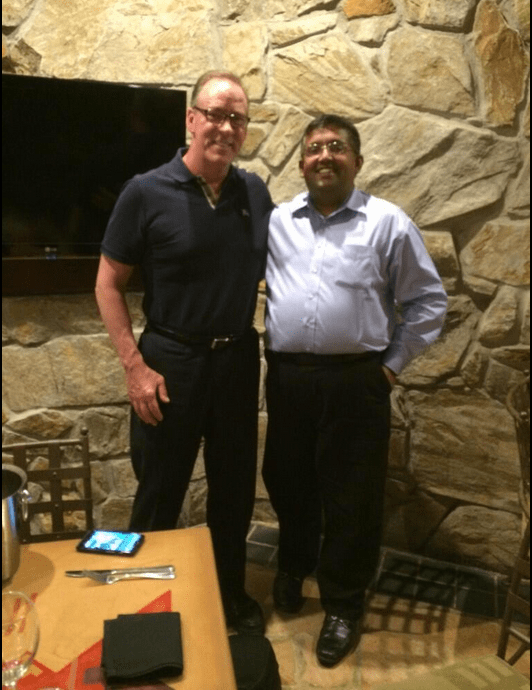
My boss, Max Schireson, announced yesterday that he is stepping aside as the CEO of MongoDB and will become the deputy Chairman of our board. And he probably wrote the best piece ever that I have read from an outgoing CEO http://maxschireson.com/2014/08/05/1137/ .

IMG_0606.JPG


Last year, when I was considering employment at MongoDB – there were two things that drove me to that decision primarily. First – the promise of the product (which did not exactly need much convincing to be honest). Second – the chance to work with and learn from the most unusual CEO I have ever met . I had a few other options at great companies – and they had great CEOs too. But those were people who fit the “normal” definition of CEO – 100% extroverted, totally sales focused, impeccably dressed , driving a car as expensive as my home , bashing competitors in every sentence and selling me hard on why working for them was the best choice ever.

Max was a 180 degrees different from that ! If he claimed to be the CTO to me – I would not have suspected otherwise (well, at least till I met Eliot, the real CTO). He could switch from discussing business strategy to discussing query parallelization and database locking without missing a beat. 

My first meeting with Max was at the old MongoDB office in University Drive in Palo Alto. We had a good conversation – but I left that meeting with a feeling that he probably did not see a role for me. He barely looked me in my eye ( something I have been accused of in the past too when meeting people for the first time, and a “problem” that I have had to work really hard to minimize) – but he asked me a lot of questions on what I liked and not liked and so on . As you can imagine – I was confused on whether he was totally uninterested or REALLY interested in what I brought to the table.

So like what anyone else would do these days – I googled him, and found his blog. It was a fascinating read. Once I figured out he was a math geek – it all made sense to me quickly 🙂

Max invited me to meet other executives and founders and investors over the next few weeks . And he and I met a few times over breakfast and lunch in various Palo Alto restaurants. And in each successive meeting – the quality of conversation kept getting better (and yes, we looked each other in the eye a whole lot more) . Throughout the whole process – he never once pushed me to expedite my decision, or tried to sell me hard. He explained everything logically and made it clear that it was my decision to be made in as much (reasonable) time as I needed. I am usually pretty good in replying to emails on time – Max was about as close to real time as someone can get when I had a question for him. 

Max’s youngest daughter is the same age as my daughter – and I could clearly see how much he cared for his three kids and his wife. and how much he missed being with them given his busy schedule. That is something I could readily empathize – I struggle with that all the time too. I would not have had a good career if my wife did not make huge sacrifices. One day not too far from now, I hope I can do for my family what Max just did for his. 

It is not an exaggeration to say – when I accepted the job, it was as much about MongoDB (the product and the team Max had assembled) as it was about having a chance to work with Max. And after I joined and started to know other colleagues at MongoDB better – it was clear that this was a common theme. 

Max is sharp as the sharpest CEOs I know in technology. He can assimilate a lot of information quickly and run what-if scenarios . He is as passionate as anyone else at MongoDB today – but I have always admired how he put his head before his heart when he made decisions. When he felt he made bad decisions, he had no difficulty in acknowledging it and taking corrective actions. I have worked for him for only 4 months and I have broken a fair bit of glass in that time – and not once did I had to pause and think whether I had his support. If he wanted me to course correct – he just told me so. I can’t express in words how much it means to have a boss that gives me operational freedom, and still be available to help any time I needed his counsel. It definitely has helped me adjust my own leadership style.

Max says this in his blog

I recognize that by writing this I may be disqualifying myself from some future CEO role. Will that cost me tens of millions of dollars someday? Maybe.

My response is – you are absolutely wrong, Max ! Whenever you decide the timing is right for you – I think there will be plenty of great CEO opportunities for you to choose from. Thanks for everything you did and continue to do at MongoDB, Max . You have set the bar high for all leaders in making tough decisions for themselves and their companies . Rock on !