Happy birthday Keralam – there is no place like home


November 1 is the birthday of my home state of Keralam – a place we lovingly call God’s own country.

I was born and raised in Trivandrum , the capital of Keralam . And to me – there isn’t a place more beautiful than Kerala on this planet . I am generally quite happy with my life with very few regrets , but the one thing that I hold myself as an abject failure is my (perceived) inability to make a decent livelihood while staying in Kerala . For record – It’s where I want to spend most of my retired life .

In school – Malayalam was my favorite subject . Its a language spoken only by Keralites , which in the grand scheme of things is not that big a population . Yet the quality of literature is astonishing . I don’t have the literary abilities of Changampuzha – but I have the same romantic notions of the language that he did . I am fairly sure the poet was rather high on alchohol and/or drugs as he penned these lines and most of his work in general 🙂

I have a pretty good collection of Malayalam books with me . Every year, I pick a few and read them again – it’s fascinating how much more enjoyment I get reading them again as my own life experiences become more varied with time .

I have often wondered why something that has failed the world over like communism found roots in Kerala . The novels and dramas of the time give me a good idea of how the movement gained prominence and became deep rooted in our psyche .

More than the “serious” stuff – it is the sattire and humor that has stayed with me . “Sanjayan” is on my all time favorite list when it comes to stuff that makes me laugh out loud and think deeply at the same time . Those essays are a league apart – and have definitely influenced how I view society.

That said , the king of sharp wit , humor and sattire was Kunjan Nambiar . He used fairly simple language and the context of stories in Hindu holy books – and generations of Malayalam readers have been his fans . I am sure that will continue for many more generations – his brand is timeless . I use his parts of his poems – usually translated to English – in many a situation where a little humor could help calm down someone at work .

Like these words that Hanuman used to calm down a pretty worked up Bheeman http://youtu.be/_OU04lw1dpM

Not that it helped – Bheeman was not convinced and explained what I think of as “the original definition of Catch 22 ” . In Bheeman’s view , Hanuman ought to be killed for being such a nuisance . But killing such an old defenseless guy will give a bad name in society for someone like Bheema . On other hand if he is not killed – Hanuman will continue to irritate Bheeman with his wise cracks . Quite the dilemma 🙂 http://youtu.be/Vm2KxptrmDI

There were some serious philosophers too that impressed me . The one that comes rushing to mind is Ramanujan Exhuthachan who penned the Malayalam version of Ramayanam , in a very creative way . It is as if it was narrated by a beautiful little bird . Here is a snippet on the folly of chasing material benefits as explained by Raman to Lakshmanan . http://youtu.be/iDAM3vIe-kM

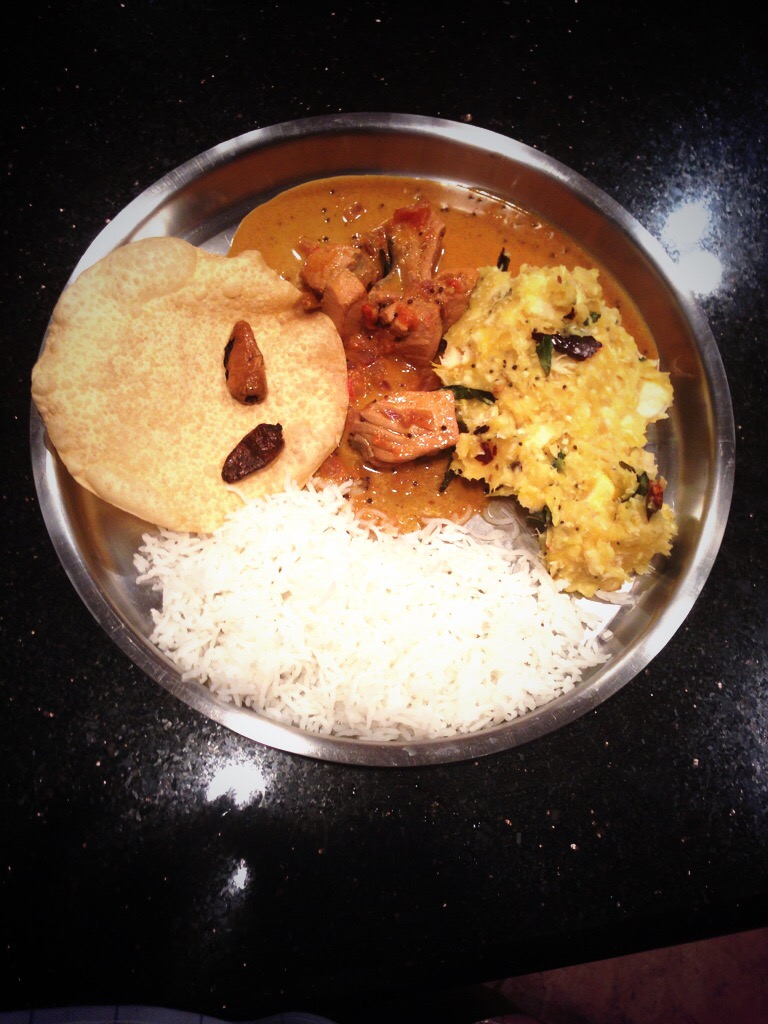
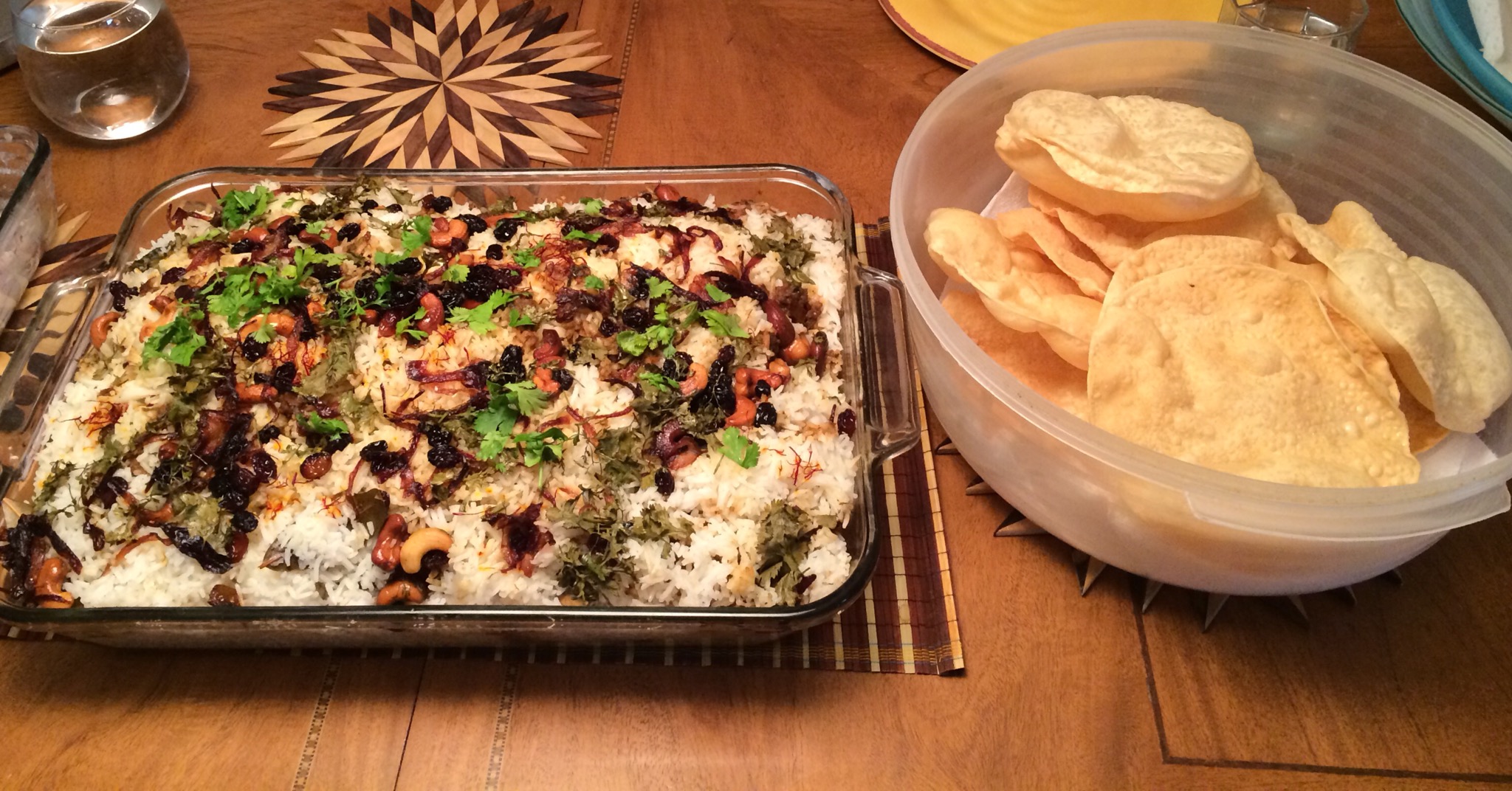
Enough with the language itself – what else comes to mind ? Of course the food ! Whatever the research says about carbs being bad – I hold “Sadya” as the ultimate balanced feast a man could eat . How many dishes can hold its own against a classic biriyani ? And is there a dessert more delicious than palpayasam ?

IMG_0272.JPG

IMG_0590.JPG

IMG_0298.JPG

IMG_0479.JPG

Kerala was the original spice capital of the planet . Vasco de Gama found his way there to trade spices . It did not end well for Kerala , but the western culinary world got a real good blessing in the process . Many of my friends love Indian food already – but they base that opinion on the chicken tikka masala served in Indian restaurants. For the record – that is not authentic Indian food , and we don’t cook that stuff at home. How I wish there were a lot more Kerala restaurants in US and Europe . It’s my dream – a dream shared almost by every non resident Mallu – to start a chain of restaurants in US that serve Kerala cuisine exclusively some day.

Kerala has a lot of good things going – almost 100% literacy , highest ratio of women to men in the country , great universities ( my grand dad , dad and me went to the same university ) , lowest corruption in India and so on . It also has some deep rooted problems – like the extreme activism by unions that has completely killed off most industry . Irony is that while mallus love to join any random strike in Kerala – I used to pray for strikes while in college – they are completely happy to work hard once outside Kerala . So while Kerala has no industry to claim fame , it can boast of a lot of inflow of money from ex-pats .

There are plenty of missed opportunities too . It is naturally beautiful – plenty of greenery , beaches , great architecture etc . However , while it has improved a little , Tourism as an industry is still largely an amateur game . Kerala doesn’t value private sector all that much . People mostly sit back and expect government to solve all problems .

Another harsh reality is that public hygiene is constantly coming down . The state badly needs infrastructure for things like garbage disposal – and the citizens need a culture of not littering . Again – it’s a problem that can be solved if public and private sector comes together . But that is against the grain for our culture – we do expect government to solve it .

Despite occasional problems – religious harmony is pretty good in Kerala compared to many other places I know of . Hindus , Muslims and Christians live peacefully there . Right in palayam – roughly the downtown area of Trivandrum – there is a big mosque , a big church and a temple all next to each other . The Hindu temple practically is next door to a fish and meat market . I went to a Hindu primary school , a catholic high school , a Muslim engineering college and a government run business school . I have never had a problem with another religion in Kerala – and I hope it stays that way for ever .

I think I have rambled way too much on this – totally got carried away with all the nostalgia . Hopefully I will be there in Trivandrum in couple of weeks for a short visit

Where does IBM go from here ?


As always – all of this is just my personal opinion here .

As a former IBMer, I was absolutely delighted to see that the IBM CEO finally said last week that the company is letting go of its 2015 EPS strategy. The best time to do that was the day she took over as CEO, but better late than never.

It was a ridiculous goal to begin with. The board and the previous CEO Sam Palmisano did not set Ginnie and the company up for success with this EPS of $20 by 2015 goal. I don’t know too many employees or executives in the company that truly believed this goal was achievable. IBM is like the military in many senses – it is a command and control style organization. So when the marching orders came, people shook their heads and then dutifully went out to try their best to make it happen. If there was a corporate equivalent of a death march – this would surely have made the shortlist.

There are only three ways in general to boost EPS

1. Cut cost
2. Increase revenue
3. Buy back shares

IBM tried as hard as they could on 1 and 3, but doesn’t look like they did much on 2.

For sure – IBM has a LOT of management overhead. Between all the companies I have worked for and have consulted to – I don’t think there is a more matrix management oriented company than IBM. When I had my first quota carrying role at IBM, I remember five or ten people (most of them I did not know ) would check in to see if I am on track to close a given deal. Most of them just managed spreadsheets . This is just the sales side of the equation. Similar kind of overlay functions existed in every part of IBM. So, yes – Sam absolutely was right in assuming that he can cost cut his way to EPS nirvana just by firing people if nothing else worked .

Unfortunately – that is not what happened, at least as far as I know. The top heavy organization more or less continued to exist – probably because they were the decision makers. Instead the people who got cut were the ones who were paid a lot less, and who actually had skills to do actual work. Well eventually some of the top management also got their pink slips – but more of a too little too late case.

The double whammy of a result is there for all of us to see – revenue going down all the time for last several quarters and then later profit stopping to go up .

IBM did try to buy back shares as a way to boost EPS . (IBM also pays a good dividend every quarter ). It helped for a while – but then that is the money that did not get spent on buying companies or reinvesting back in its own business . This is money that could have resulted in new revenue , but that is not the path IBM took. I don’t have the exact math – but I think IBM spent probably four or five times the money they spent on M&A on share buy backs .

So now what is next ? How will IBM regain its glory ? Here are a few thoughts that I wish IBM Management will consider

1. Minimize the management over head . There is absolutely no way to justify 10 people checking in on every deal .

2. Sell off aggressively every part of the business that is low value . I would start with hardware and consulting – both have low value parts . What is low value for IBM might actually be what another company might need to grow . Like say consulting – there are multiple indian outsourcers who might do well to buy parts of IBM services business to move up their value chain

3. Bring back “respect for the individual” as a core value . Start treating employees on par with the customers and shareholders . Employees are the ones who need the most attention now . Take care of them , and they will take care of customers better . And that will take care of shareholders a lot better over the long term than buying back shares . It’s the sustainable model unlike the last attempt

4. IBM has an amazing leadership training program – I know that first hand . And it has more leadership bench than most of its peers . What is missing is that such enablement is not there lower down the ranks . If IBM needs to be a powerhouse in IT again – the customer facing organization needs the kid of leadership training and attention that executive ranks get .

5. Put the best sales and technical teams possible on cloud , big data and Watson . There are plenty of good people in IBM who could be retrained on these areas. And there are experts who can be – and need to be – hired . For existing business, automate everything repeatable like crazy . Make delivery excellence truly mean customer success as much as profitability .

6. Set realistic expectations with employees , customers and the street . Set stretch goals – IBMers can meet and exceed stretch goals . Just don’t venture again to the realm of impossible targets .

Despite all its current troubles – I am still an optimist on IBM returning to its past glory . There are three things that make me an optimist on IBM’s future

1. IBMers – past and present – are a special breed . I have all the confidence that the good people left in the company are as good as any in the industry to make the turn around possible

2. IBM has a brand value that opens doors at customers across the globe . IBM needs that brand to sell more cloud , Watson and bigdata solutions to customers .

3. Through thick and thin, IBM has invested billions of dollars on research . The time to plant a shade tree was in the past and IBM got that right big time . That has already paid back IBM many times in past and I am fully confident that it will continue to do so .

As they say , Once and IBMer , ALWAYS an IBMer !

Logo changes


Yesterday someone mentioned that SAP changed its logo again . Dennis Howlett even posted a blog saying he loved it . http://diginomica.com/2014/10/22/digibyte-new-gold-sap-logo/

Den says the logo looks masculine , gold is an unusual color (to me it looks like an orange not gold ) and will get more attention and that the cross bar of A looks more like a smilie now . I don’t disagree with any of that

What I don’t understand is – what is the outcome SAP expects from this logo change ? Will it make more customers click on SAP digital content? Will there be more leads for SAP ? How does this change connect to Bill’s theme of simple ?

Logo does look beautiful and I want to congratulate its designer . Personally I preferred the old Blue , but that is just my taste . But I have no idea how it adds value to SAP or its customers . Would be great if a marketing expert could explain it . I am not saying this is a bad logo – just that it has picked my curiosity seriously . It’s a non trivial undertaking for a company like sap to roll out a new logo . I am just looking to understand the rationale of doing this .