Re-learning leadership , again


For the most part, I have had a pretty good career so far – not spectacular by any stretch of imagination , but can't complain either . And I attribute most of it to having great leaders who helped me grow.

My interest in leadership started for a simple (and awkward) reason – in the early part of my career, I had some really awful managers. My solution was to stand up for what was right in my mind and often leave the company as a result. So by the time I was given a leadership role – I was determined that I should not let any one in my team go through the trouble I had in the past. Roughly at the same time – I also had the good fortune to see what great leadership looks like (finally!) and it helped set my expectations more appropriately.

One thing became abundantly clear to me over time – learning how to be a good leader is a journey and never a destination . There are no "here are 12 things to do" that serves as a magic bullet . You need to constantly calibrate where you are and seek the needed help to improve. This unfortunately doesn't mean that I followed through on it – I have some ways to go 🙂

Thanks in a large part to the less than stellar leadership I got when I started out – I have become a big fan of mentoring young men and women who are starting out in their careers. I also spend a lot of my time mentoring first line managers . This serves two purposes – the highest energy comes from the entry level colleagues and I get to channel it for the good of the business , and I don't become a bottleneck to the process since the first line managers get a better perspective on why their success is totally dependent on the success of their team.

To enable this behavior – I have long had a rule that anyone can get 15 mins on my calendar , no questions asked. Not everyone takes me up on it – but several do. And it does get overwhelming at times.

This is when my friend Stephanie Anderson, an HR leader in IBM, gave me some invaluable advice . She told me "You cannot mentor everyone – you need to let others help you". Pretty straightforward and I should have known it – but the truth is that I did not . I am pretty good with delegation – as any of my direct reports can vouch for . But when it comes to mentoring , clearly I sucked at delegation . So thanks to Steph giving me timely feedback – I have woken up to the reality and have started enlisting the help of others to help mentor more of our younger colleagues . Thanks Steph ! And since no good deed should go unpunished , I am now pushing a bunch of mentoring requests to Steph as well 🙂

The first few years of my professional life was actually quite calm – I learned programming and project management and got to apply it at projects and had the time to develop my skills. I did not have to do much more than take classes couple of times a year to stay on top of it . Then it started changing – technology started moving at faster pace and I realized I need to get into a "learning is for all of your life" paradigm . And that has only helped me in my life – actually on personal front too . Folks starting out today don't have the luxury I had of starting slow !

For a long time, I wondered why I was signed up for classes like "executive presentations" and "executive negotiations" when I was not even close to being an executive . But in hindsight – pushing me to take those classes was one of the best things my mentor Ken Englund did for me more than a decade ago. It taught me that the sooner you learn things – even if they are hard and they don't apply immediately to your work – the faster you make an impact . And trying new skills in early part of your career is a lot less risky than trying them later.

So when last fall when our North America managing partner Ismail Amla asked me to sponsor the core consulting school for senior managers , I jumped in with both feet. I still wonder why he chose me given he was fairly new to IBM at the time and we didn't know each other very well at the time . In any case I said yes before he changed his mind 🙂

I was also taking over a new day job running a large ( well large for me, not really that large for IBM) portfolio in parallel . I sure had my moments of stress – but it was the best experience in my time at IBM bar none .

To begin with, I had no idea how much care and effort it takes to put on a comprehensive learning event – and the Pre and post school activities . Fortunately I was paired with experienced learning experts like Debi Steinbacher , Lorraine Rapuano and other colleagues . We also managed to find a team of volunteers from amongst the partners and associate partners in the firm to be the teachers . It's pure magic when a team of passionate people come together with a common purpose – and now Bee School has taken a life of its own and is growing from strength to strength . And here is a shout out to Pooja and Andrea for coming up with the name "Bee School" !
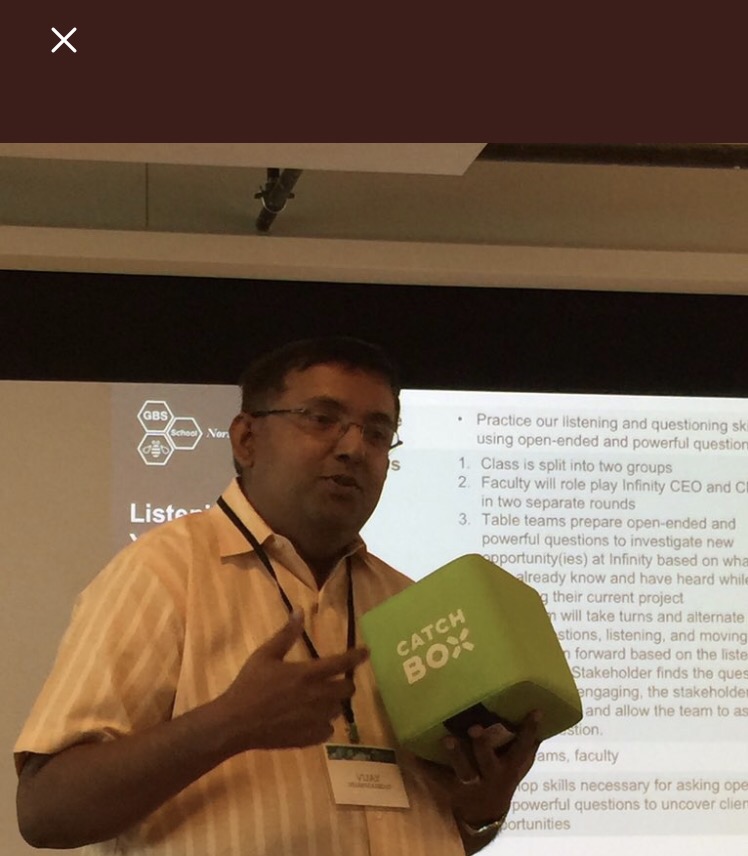
My favorite part of these schools are the "ask me anything" sessions . When you can ask and answer hard and often uncomfortable questions, you start growing !

Last week at dinner, Lorraine told me "you are the Zen master of Bee school" given how I apparently had a calming influence during the chaotic times we went through in preparation . Well, if I was Zen – it's only because I had, and continue to have, full confidence in the amazing team around to me . And also along the way , I learned that it's foolish to stress about things you can't control 🙂

Success breeds success – and the confidence I got from being part of this team that put together Bee School led me to start a second learning initiative that I lovingly call the T-school which is where we focus on technology training , like AI and IOT . We ran the pilot couple of weeks ago and it was a lot of fun hacking AI solutions with 30 of our new engineers . And again – it only happened because we brought together a team that was super passionate about the cause and leaders from the business took time out of their day job and came in as teachers. I lucked out having a great partner in Andreana Miller from our learning team and a bunch of new friends from our global team .

And in the process, the Bee school got a fantastic upgrade too . Susan Wedge , a dear friend and a great leader of our public sector business , took over Bee school sponsor role from me . I can't wait to see her take it to even greater heights !

Not only was the investment in learning good for my soul and fun for all of us – it had some side benefits too in my day job . I now have a MUCH better appreciation of what great looks like and how iteration is far superior to aiming for upfront perfection . And best of all – there are now several new ideas for making our clients more successful . It's just fascinating watching what happens when high potential people are given the tools and freedom they need . Pure magic !

One last point before this plane lands in SFO – we all know that asking for help is a good thing . What I realized in the past few months is that asking for help should not be just to your senior management – a lot of help can and does come from your team as well . I can't tell you how cool it is to see my young engineers and consultants jump in and solve problems with high quality when I requested their support . And their energy is infectious – and has convinced me beyond a shred of doubt that I have more help to ask 🙂
Googler’s Screed


Or perhaps I should say Xoogler's screed instead , now that he got fired .

Strangely, the first thing that hit me was the word "screed" since the last time I heard the word was couple of decades ago in engineering college . Perhaps "manifesto" associates itself with "communism" and hence "screed" seemed to be the more appropriate word.

I went through a series of emotions as I read about the screed . It started with anger, and that is the only reason I did not start typing my views on day 1. I needed time to process the information . And doing that increased my respect for journalists who had to break the news without much time to look at it at depth , as well as Sundar Pichai who had to take a decision quickly on what to do with the guy who wrote the document . I am glad I took the time before posting a rant – it was quite educational to read many different opinions and talk to many fellow engineers, male and female .

One thing is abundantly clear – Google was put in a no-win situation. If they didn't fire the guy, they would get painted as anti-women . If they fired the guy – they will be accused of shutting down diversity of thought.

There were a few points in the debate on both sides that I thought were rather weak – like Damore's first amendment rights , and whether he should have written such a document during work hours. Google is not a government entity and first amendment should not be a big consideration in letter or spirit in this context . The guy attended a google class on diversity and wrote it in response . If google offered the class during work hours , I can't blame him for writing a response during work hours and circulating it .

I am an engineer myself and hire engineers to work with me – and it was extremely painful to read the document and realize it was a fellow engineer who wrote it . It just felt like someone did the profession a big injustice – and perhaps it's an over reaction . In any case – I would not hire a person as an engineer in my team if I suspect a significant lack of empathy . Not going to belabor the point – this is a brilliant take on it and you should read it .

The tone of the manifesto is quantitative and dispassionate from what I could interpret . When criticizing it, however, there seems to be a penchant in media to refer to it as "quasi-professional" and "pseudo-scientific" and so on . Even though the opposing arguments looked strong to me , trying to attack the tone of the writer as opposed to his central ideas and facts(?) diminished its effectiveness.

While I can't say I have a first hand understanding of what it is like to be a woman in tech – I can extrapolate from what I went through as an immigrant and have no doubts how difficult it must be . I also grew up in a family of strong women in India who fought all odds to thrive in a male dominated society . I was not in the minority growing up in India – and my appreciation for its value only happened after I moved to USA in my early twenties .

When I first came to this country, I faced a fair bit of Discrimination as an Indian programmer in the midst of mostly white male programmers – insults to my intelligence , the food I ate , the music I liked , my accent and so on were common place. I also had some very kind managers and friends and co-workers who considered me as one of them and helped me cope . For the most part, I don't feel it anymore – I developed a thick skin over time and larger number of Indians are there in the workforce now for me to feel alone.

Damore is absolutely entitled to his opinions like the rest of us – we live in a free country. But as an adult, he should also know that actions have consequences.

I think where he lost the plot of having a good debate – instead of the storm he caused – was in quoting studies and stating that all of it applied only to populations and not individuals , but then going on to make recommendations that don't follow that thread of logic . That gave me the impression that he was not arriving at a conclusion by building an argument ground up, but just finding a way to substantiate what he always believed . Irrespective of the content , that is not the hallmark of a good engineer .

He does state that he is supportive of an inclusive workforce and agrees that sexism exists. Unfortunately the recommendations are either too vague , or not backed by consistent logic. It came across like "Current diversity program sucks, so let's get rid of it. No diversity program is better than a partly effective one". Huh ?

The charitable side of me wants to believe it was mostly ignorance and lack of skill that caused him to write it the way he did , as opposed to totally evil intentions . In any case – he earned the backlash fair and square in my opinion .

To begin with, Google had a lousy episode recently of telling DOJ that 100K USD is too much money to spend on compiling payroll information for gender equality. Now if they also did not fire the guy who wrote the awful memo – it would have been an even bigger nightmare.

I do grant one thing Damore raised . If you hold conservative views in Silicon Valley, it's rare that your views will resonate in the work place, and there is a good chance you will be out-shouted . Unless of course you are someone like Peter Thiel . It's an extremely left leaning place and the lack of inclusion is not just about gender, it's about diversity of thought too .

One thing google needs more than anything to keep its leadership in the market is retaining and attracting top talent . They cannot afford to risk a bunch of their talent walking away if they think google doesn't support their ideology . There is no non-compete in CA and many of these engineers are already rich and will find multiple jobs quickly with google on their CV . Even if no one walked out of the door per se , which development manager would choose to have Damore in their team after his views became public ?

If forced to choose between the support for gender diversity and thought diversity – I firmly think gender diversity should win every time . Ideologies evolve with time and mistakes can be corrected relatively quickly , but gender doesn't follow that path. Solve the gender diversity and it will be fair game to have absolute focus on thought diversity .

In my view, Sundar Pichai absolutely did the right thing by firing the guy – but google leadership , HR and PR departments should get a B- for how it was handled . As a friend mentioned on Facebook – the only thing worse than scheduling the all hands was canceling it .

The net goodness out of this episode is that it sparked debate yet again on the importance of diversity . The sad part is that without such incidents, it doesn't get the attention it deserves.

And Jerry Says : A Path to SUCCESS with Advanced Analytics


Folks, I am very proud and happy to have my dear friend Jerry Kurtz do a guest blog on my site. Jerry runs the Cognitive and Analytics businesses in my portfolio, and is a long time IBMer. He has been in this field for 30 years across SAP, Managed Business Process Services and Analytics and now Cognitive for last few years. He is a man of many talents outside work too – a very good singer – he is the lead singer of the “midlife crisis band”, a competitive golfer, and an overall good dude to hang out with. He lives with his wife Amy, his daughter Emily , Son Adam and his 3 year old fur kid Baxter, a Chocolate lab. You can find him on twitter as @jerry_kurtz 

Jerry with Fish

Take it away, Jerry !

I will start with sharing highlights of my beliefs regarding the “10 Fundamentals of Successful Advanced Analytics Programs”.  I hope to go deeper into each of the 10 in subsequent posts.  Also, for the purposes of this blog, I will not define each element of analytics.  Rather than keeping “predictive” separate from “optimization” and “prescriptive” separate from “cognitive”, let’s just call it all “Advanced Analytics”, shall we?  We shall…

Analytics Screens

Fundamental #1 – Establishing a “Balanced” Advanced Analytics Strategy. Any analytics strategy must have three basic things.  These three basic things may seem like “motherhood and apple pie” to some of you, but it’s amazing to see how many times we have seen Fortune 500 companies make mistakes on these basics.  More on case studies in future blogs.  Your analytics strategy MUST HAVE:

  1. A Business Capabilities or “Use Case” roadmap that answers the question “what solutions do we need to implement for our BUSINESS, USERS, and BUSINESS PARTNERS to achieve our business goals”? This is the value side of the equation.
  2. An Information Foundation roadmap that ALIGNS very tightly with the Business Capabilities roadmap. A strong data foundation does not in and of itself create value (with few exceptions), it ENABLES the full range of business capabilities and VALUE to be rolled out over time.  The above two strategies MUST be aligned with each other to maximize value.
  3. An Organization / Governance approach and roadmap that also aligns with overall business strategy and the above elements of the analytics strategy. We have seen that the “technology can be the easy part”. It is often the organizational structure, culture, and related politics that gets in the way of success.

Fundamental #2 – Establish a program goal of “10X value to cost” and “Self-funded”If you have the right level of executive sponsorship and you scope analytics programs properly, you can target at least $10 of hard value for every $1 of program cost.  Also, if you prioritize business capabilities the right way, self-funding is achievable within 90 days of program start. If your analytics strategy is not meeting these metrics, you should probably rethink your strategy.

Fundamental #3 – Think and Act with “Parallelism”Self-funded analytics programs can’t be achieved by working “serially”.  We have seen clients say, “we need to get our data fixed first, then do basic Business Intelligence and Reporting, THEN we will do some advanced analytics”.  In today’s world, however, parallelism is key. For example, some advanced analytics can help fund other elements of the program.  New business capabilities can help fund data transformation.

 Fundamental #4 – Having the right level of business sponsorship Without going into too much detail (yet) I will summarize my experience that the most successful analytics programs have senior and clear business sponsorship / ownership.  In the last couple years, my most successful analytics roadmap / implementation program was sponsored by the global CFO.  Just an example.

Fundamental #5 – Picking the right place to start  If you have 50 new innovative ideas for Advanced Analytics use cases, the best place to start is usually on use cases that (1) have strong executive sponsorship / business need, (2) have data readily available to solve the problem, even if in multiple sources, (3) LOW COST but HIGH VALUE for Phase 1 (e.g. Proof-of-Value).  Again, this may seem basic, but we see mistakes all the time.  Last year, I walked into a client that had started with a global management dashboard across 10 countries.  Very expensive and very time consuming.

Fundamental #6 – Scaling beyond science projects For now, let’s just say that the technology aspects and “finding smart people” will be the easy part.  The “soft stuff” will make or break the project.

Fundamental #7 – Embrace diversityI grew up in the ERP market where there was a fair amount of homogeneity across project resources e.g. similar background, similar training backgrounds, etc.  During my last several years in the Advanced Analytics space, I have met hundreds if not thousands of people, and I can best summarize them by saying that “they are all from different planets”.  While the incredible diversity in this space can make it much more difficult to assemble a “winning team”, I personally LOVE the challenge and so should you.

 Fundamental #8 – Teamwork / collaboration – At the risk of being too high level for now, I will summarize by saying that it’s all about resource “mix” including both mix of skills but also personality types.  For example, I would rather work with an A- data scientist who works well with others rather than an A+ data scientist who is always “the smartest person in the room”.

 Fundamental #9 – Analytics practitioners must be life-long learners e.g. “Adapt or Die”As Thomas Friedman explains in his recent book Thank You for Being Late, we have reached a point where technology is changing faster than humans are able to adapt. We and our teams had better keep up with rapid change or we risk becoming obsolete.  This challenge can only be overcome through life-long learning and constant, adaptive change.

 Fundamental #10 – Be Hands OnWe ALL need to find ways to be hands on with analytics technology.  If you are “only” a project leader or a business analyst or a practice leader, you should find ways to “sign-on” and learn your trade at a hands-on level.  Generalists with minimal technology savvy will struggle in the coming years, but “hands-on” specialists will thrive.

I hope you have enjoyed reading this as much as I have enjoyed writing it and sharing with you.

Thank you.

Jerry