How will the IT services world look post Corona pandemic ?


It’s been a difficult few weeks for me personally . First I lost Hobo . Then I had to rush to India since my father fell critically ill and passed away . It was not clear if or when I could return to US given the Corona virus situation – and after being away for three weeks , I got home yesterday . It took me about 30 hours door to door and most of that time I was thinking about how the world around me is evolving at a break neck speed .

Obviously I have no crystal ball to gaze into the future and I have done no scientific studies on this topic either . And as always – these are purely my personal opinions and not that of my employer .

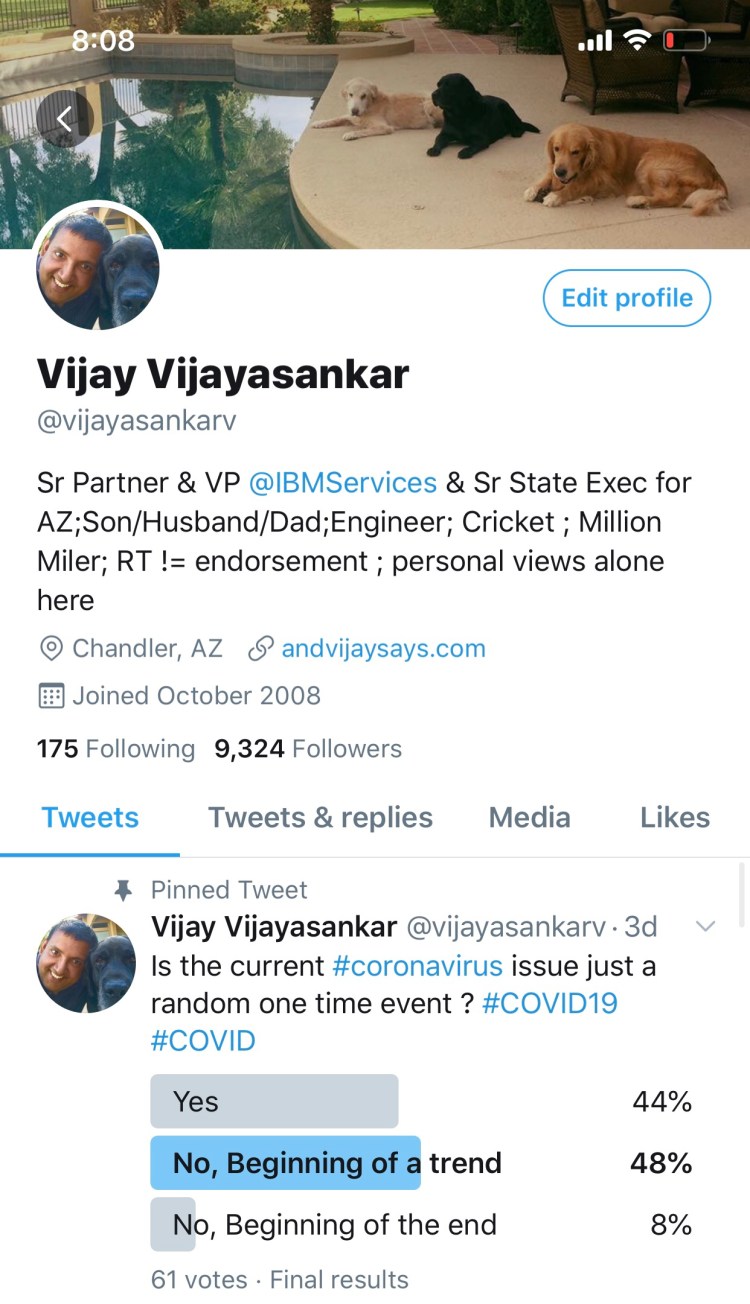
I have been thinking about whether this pandemic is a one time thing or whether this is a pattern we should expect in future . A quick poll on Twitter was the closest to a checking around I could do from TRIVANDRUM .

This is what the handful of people who responded thought . It aligns with my own thinking – we should consider the possibility that this could be a trend and evolve our personal and professional lives to deal with it .
So with that background – let me share what I think we should plan to deal with in the world of IT services . Some or all of it may apply to other industries too

1. Obviously , we will learn to work better from remote locations

I have worked from home and client locations nearly all my adult life . I offered some quick tips last week when I saw posts on social media by people who seemed to be struggling with the transition . I absolutely think any temporary loss of productivity can be mitigated with better connectivity , processes, education and tooling . I say this significant conviction because I didn’t see any serious loss of productivity when a big part of my own team and I went remote as part of invoking our business continuity plans .

2. Travel and co-location become less important

It might take a few years to be fully embraced – but the difficult times we go through now will provide enough proof points that we can function effectively and efficiently without all being in one location . Consultants flying every week to a client location (or commuting for hours every day) is a habit we have carried over from a different era (when there was no internet and remote communication was ineffective and costly) and we can finally stop doing it as a primary mode of delivery . Face time will always be important – but it will probably come at a premium in future .

The money saved from all these can either go to bottom line or even better, spent on more value generating projects . We will all be doing a greater service to the only planet we can call our own !

3. Less divorces , and more happy families

It’s a touchy topic and taboo generally to talk about – but I am going to say it anyway . I personally know several people who ended up in divorces because of the nature of our work . I think this will change for the better if the low value travel in our line of work is minimized or eliminated .

I also know several friends – and many of them women – who had to make a hard choice to not raise a family because of the constraints of work ( mostly related to travel ) . I hope they have more choices in this matter going forward.

There is a part of me that does worry that families will need some adjustment when we all work from home . But hopefully this can be worked out with relative ease if we approach it consciously . I have some thoughts – which I plan to pen eventually .

4. Different measurements

The general measurement paradigm for staff consultants is utilization and for executives it’s sales . If and when work becomes more remote – I think we will have to switch to a different set of measures than billable utilization . This is perhaps the hardest change this industry will face and we better prepare for it now .

I also think the way to measure sales will also change. Revenue in the accounting sense of the word may not be enough when cash becomes even more important for businesses . Not sure if DSO is the right measure – but some cash related metric might need to be incorporated into sales metrics . Also important will be customer retention , Client satisfaction etc . It’s not that these things are not important today – just saying that we may change what’s peripheral now to a more primary component of comp models .

5. More pressure on the bottom of the pyramid – for both providers and clients

Back in the day, young consultants got into long term projects at low billing rates and learned the trade in an apprenticeship model . That’s already hard in today’s world with project sizes and time lines shrinking . Now when remote work becomes mainstream – it will be much harder to bring inexperienced new hires to the level of skills that is needed for actual projects .

This also will need some serious rethinking by the service providers along with their clients .

6. Project delivery has to evolve

Every aspect of the delivery life cycle will need to evolve and probably evolve faster than we are used to . For example – a lot of shops have already stopped splitting a work product between onsite and offshore teams . Instead they give fill autonomy to remote teams so that they are self contained . That helps minimize people needing to wake up early and sleep late everyday . That’s the kind of culture that needs to become mainstream in IT services.

I am used to globally distributed agile – but honestly it took some time getting used to it . It’s a significant change management issue for most companies – service providers and clients alike . And it might need a new kind of leader to make it happen and stick with it .

6. Automation will increase manifold

One of the biggest take always will be that people are the biggest risk to an Enterpise when the risk is biological in nature like a pandemic . So perhaps even for some wrong reasons – I expect the focus on automation to increase manifold just to decrease the dependence on humans .

But in the same breath – I have to say that what I see around me now is that automation has not replaced human decision making yet . In fact a lot of human effort and thinking is going on at the moment to mitigate the unique risks that are coming to light .

So I guess the best way to think about this is that we need highly differentiated skills to be employable in the future world of services . Again – I have way too many thoughts on this topic that I will post in another blog .

7. Security is probably the new black

Security was always important no doubt – but as we get even more distributed in terms of delivering work, I think it will become a more central issue in IT than it already is . For a long time – all consultants who were good at analytics have had a bit of an edge in the field . I think that will continue of course – but now security (specific to your domain) might be that extra skill set that will help you stand out .

8. Massive consolidation will happen

Some amount of consolidation has been happening already and I think it will pick up significant speed . The mid tier companies probably won’t have a viable way to continue and will have to merge or get acquired to stand a chance to survive in the evolving market .

Unfortunately I also think a bunch of those mid tier companies won’t make it and will just disappear . Given the gloomy nature of the topic and because I have dear friends who work there – I will resist naming any names .

Even the ones who will stay around – I don’t think they will have big pools of full time employees anymore in the middle to long term . I fully expect vast majority of these firms to depend on gig workers to get things done for their clients . And commodity skills will probably become a mainstream online platform business where clients and providers can both buy .

9. Systems integration business will grow

I know it’s a hot button topic for several people I know and respect , who believe cloud will kill SI business . That’s not how I see it . I do think SaaS and other cloud models will continue to grow . And as it grows , integration and analytics challenges will grow as well . Consequently I think the SI market will continue to be a good employer for a long time to come . The kind of work will shift over time – but the effort to integrate will continue to grow for a long time .

I am not sure yet on whether in-sourcing of IT will get affected or not in future . I will be keenly observing and if I see any visible common trends , I will share in a future blog .

10. Redundant collaboration tooling

As we increase our dependence on webex , zoom , teams etc – those services going down will have significant issues for our businesses . I am sure those companies will become very good at providing highly resilient services – but I can’t imagine any company risking their business with just one tool anymore . Maybe they will when SLA from these providers are that good – and I am keen to see how this evolves .

I am very interested in your views on this topic . Please leave your comments and I look forward to learning from you .

Post Script : here is a little video Dennis Howlett did with me on March 23, 2020 on this topic


https://youtu.be/yz30WT04nWc

Managing Top Talent – Lessons from Indian Politics


I have now been in India for the last couple of weeks. Even though I am a US citizen now, I have followed Indian politics with great interest all my life . I have always stayed away from political party affiliations all my life – both when I lived in India as well as when I moved to USA .

Needless to say , all these thoughts are expressed purely in my personal capacity , while looking at the world through the eyes of a management consultant . I make no judgement of what these parties stand for etc in this commentary .

When I read the news of Jyotoraditya Scindia leaving INC and joining BJP, I couldn’t help thinking about the parallels with classic top talent management in the corporate jungle I am familiar with .

The common factor you see in top talent in any field is Ambition – be it for the pure thrill of winning , be it for money , titles , social status or whatever else . When channeled carefully , ambition works in favor of the organization . When ignored overtly or covertly, the effects could range from extremely low value add to outright sabotage .

1. You can’t act if you don’t know what they want

When you spot such high talent – you should take the time to understand their ambitions and then keep up with it over time since people evolve their ambitions . I have personally been confused many times about my own team when someone asks for promotion when what they really need is a raise – but can’t separate the two without an honest conversation . If I reject the promotion because that’s all I heard directly (and I think the person is not ready to operate at a higher level yet) – I might lose the talent from my team . If I had the conversation and understood the real ask is more money – I might have a chance to retain the talent . But few years later – money might not be the big motivator for the same person – it might be the title , or public recognition or something else . As a leader – you need to know what is the ambition of your top talent at all times !

It’s not clear to me what Scindia Jr wanted ( I can speculate) – and it’s not clear if Sonia Gandhi knew exactly either . But clearly he ran out of patience after a while and walked away . His resignation letter that I saw on twitter was pretty straightforward .

2. There are always organizational antibodies , and top leaders might unwittingly enable them

Tenure is a double edged sword in every organization. Once people get comfortable being kings or kingmakers , they may find it harder to let anyone else too close to power that they don’t care for personally . Merit and potential all tend go for a toss . If the top leaders surround themselves with the same advisors for a long time – it’s inevitable that their ability to spot top talent (or know details of their plans ) will start diminishing .

When top talent sees a leadership vacuum above them, their instinct often is to see if they can fill that vacuum . They enjoy strong leaders they can learn from . It’s one of the difficulties with matrix management systems that talented people might find it odd to see inconsistent quality of leadership . When it gets to a degree they are not comfortable with – they start planning their exit .

In MP politics – it’s possible that Digvijay Singh and Kamalnath perhaps acted as the antibodies preventing Scindia’s growth . They both enjoy the support of the first family .

From the outside, I cannot divine who holds power in INC anymore . In theory it has to be Sonia Gandhi and her two kids . But Rahul has clearly said he is not in charge . So I am guessing it’s some combination of the old guard war horses like Ahmed Patel and AK Anthony who are holding the fort together . That might have at least partly convinced Scindia that the juice is perhaps not worth the squeeze to hang on much longer

3. Top talent might not even make a big fuss when they don’t get what they want

This is a big problem – a lot of high caliber people do their work and wait for their leaders to reward them for it . They may very gently raise it with their leaders from time to time – but generally stay away from getting a reputation of being aggressive . They have the confidence that they can easily get what they need outside their current organization and that is why they don’t create the fuss .

Leaders who ignore this aspect usually realize their folly only after the proverbial horse has bolted from the barn . These are not the type of people who will stay for a last minute counter offer – unless perhaps it’s earth shatteringly good !

Scindia did everything he was asked for but never got a proportionate reward . And when he left – perhaps the only offer to make him stay would have been to offer INC president’s job . And that’s unimaginable in INC – considering an ailing Sonia Gandhi has to take up the role when Rahul Gandhi walked away !

4. They build strong knit teams and take those teams with them

There is an exponential effect when you can’t retain top talent . They are natural leaders for whom their teams love to work . And when such people leave – their teams tend to be quite demotivated and will try to leave with them as well . You cannot hold people against their will for very long – and the price to pay is high . I have often seen this with sales leaders in corporate world where the best sellers generally follow the VP from company to company .

Scindia has a loyal team in MP and will naturally take his people with him to BJP .

5. While you are ignoring, competitors are watching

This is one of those strange things in life . You have extremely talented homegrown people that get taken for granted at a certain point . You might salivate looking at the talent at your competitors and worry about how you can poach them . At that point – the competitors are also plotting strategies on how to get your best people . It’s very very hard to get senior people to move when they are happy and content . But when they feel continually overlooked – it’s relatively easy to convince them to jump ship . Most competitors keep contacts warm with top talent in the industry for this reason . They wait for the right timing to make their case and force a decision in their favor .

BJP – even on a foggy day – could have seen from a mile that Scindia was not getting his due from INC . His own aunt is a senior BJP leader and CM . So they made it work and INC should have totally seen it coming .

6. Reputations are hard to win and easy to lose

Organizations that can’t hold their good people lose their reputation steadily . Then it evolves over time into a self feeding frenzy where the remaining top talent starts to wonder whether they are being stupid to hang around any longer , and start jumping ship . This is hard even when times are good . But when times are bad – this could become a real nasty problem .

That’s why in both good times and bad , organizations need to make room for people to grow . This often needs removing some from the top to make it work especially when times are bad . Those are hard decisions without a doubt . But if that’s not done systematically – the old guard will stay and not add additional value , while the up and comers will find a low ceiling and they leave .

INC (also other parties) has a long history of their leaders leaving them because they run out of runway – Scindia Sr ( who once even best Mr Vajpayee in Gwalior ) , Sangma , Pawar … there are lots of examples from the past . But when the party was in power, they could live with it . Now INC is in trouble and they can’t handle attrition that easily . If they don’t mend their ways – others like Sachin Pilot maybe the next to look for greener pastures .

So who is doing good talent management in Indian politics ?

Narasimha Rao and Rajiv Gandhi both come to mind upfront . Rao brought it talent like Manmohan Singh as his FM and that was brilliant for INDIA and INC . Rajiv brought in young talent of the time like Gehlot , Pilot and Scindia to prominence and largely those moves worked well too . But somehow INC lost that muscle after Rajiv’s and Rao’s time .

BJP seems to be doing a fine job now ( of course like INC , they also deserve some criticism on a few choices ) in building talent from the ground up . Modi , Naidu , Rajnath Singh etc all grew up the ranks and gained valuable experience before getting their current jobs . Some (though not Modi himself) were party presidents for a bit before getting cabinet postings . That investment in systematic and long term talent management seems to help them grow their influence over time .

I hope INC addresses its talent problem pretty soon in a comprehensive fashion. India needs at least two strong national parties to be an effective democracy . A democratic INDIA is an absolute must for its citizens and for the world at large .

Ten tips on working from home


There is a high chance that the Corona virus issue will force more of us to work from home – or at least remotely from wherever you regularly work . It is not an easy transition for people who are not used to doing it often and for what it’s worth – I thought I will share what works for me and maybe some tweaks will make it work for you too .

1. Upgrade to the best internet plan you can afford for your home office

It’s the equivalent of wearing comfy shoes when you have to walk a long time . You can thank me later 🙂

Goes without saying – make sure your VPN etc work fine on remote networks before you start working from home . Know the help desk number upfront and write it down somewhere easy to see .

2. Learn to walk and talk

Sitting for long periods of time is not easy on many levels . Get yourself good headsets and start walking and talking any chance you get . I often take calls from my backyard and just pace back and forth hundreds of times .

3. Let people know when you are available and when you are not

Unlike in a traditional office – working from home will need changes for schedule . You maybe able to get work done that you might otherwise we driving . So change the hours as needed and let people know explicitly via calendar , email etc . For the first few times – when mention it on your calls .

Similarly your break times maybe different . Since you start work early for example – you may take a longer break at lunch and then catchup again at normal commute hours . As long as everyone knows your schedule , you can minimize frustration

Remember – if you don’t draw boundaries around work , work will draw boundaries around you and it may not be pleasant

4. De-clutter like a maniac

You don’t need a lot of stuff around you to be productive . Keep your computer , notebook, phone , spare pens , beverage and snacks handy . Ask hard questions if you feel tempted to put anything extra near you and your default answer should be no . Again – you can thank me later 🙂

I also try to keep the printer at home away from my sight whenever possible . That has helped reduce the number of prints I take significantly .

You don’t need to work from the same location every time either . I often work from three or four different places within my home depending on what I am working on . The less things you need to be productive , the better your chances of changing the scenery . This helps me stay focused a lot longer .

5. Have a plan B and C for alternate locations

Distractions happen and you will need to work from elsewhere from time to time . Scout a few places and keep that list handy – and make sure you know how to access wifi from those locations and any limitations like whether you can talk freely , how long you can hang out there , what $$ you need to spend there etc

6. Gain agreement with your family – and neighbors too, if needed

You are still working and they need to know that you being there in person doesn’t mean that they have your attention . Develop a short hand and be consistent . Trust me – this is a lot harder than you may think at first .

7. Video is your friend when used wisely

Impersonal calls become a lot more personal when people can see you . But if you think video is a distraction – don’t switch it on . For early morning calls where you haven’t shaved and showered , just leave the video off . Similarly , don’t feel pressured to dress up for every single meeting . Remember you don’t need to switch on the video if you don’t want to

8. Work extra hard in the beginning

New environments come with new distractions . Compensate by working a bit harder till you find your balance . Your team shouldn’t have to compensate for your distractions . Get the job done and soon everyone will have faith that work from home actually is effective and efficient

Try to do some 1:1 type meetings in person even when you are primarily working from home . As much as collaboration tools are great – real face time helps !

9. Eat right and exercise

You should be doing it anyway – but it’s one of those things that easily falls apart when you are home more than you are used to . If needed , break the exercise time to two or three .

10. Careful when you drive

Work often tends to spill over to driving time . Nothing wrong with it unless it becomes a distraction and you keep glancing at your phone to see charts while someone is talking and you are driving . Pls don’t be stupid on this front .