What’s in a name ?


Romeo and Juliet is a brilliant piece of literature and every time I think of it, I remember Juliet arguing “What’s in a name . That which we call a rose. By any other name will smell as sweet” . What Juliet did not say was that when it comes to those of us with very long names – the answer is EVERYTHING !

Last name was not a big deal at all when I was growing up in Trivandrum . Till I got out of college – I did not even have a real last name . It was just an initial V that I used – and that was common practice . My name was signed Vijayasankar . V . That V stood for Vijayaraghavan – which is my dad’s first name . There were no other Vijayasankars in any of my classes – and this never was a problem . My friends called me Sankar in school and VS in college . No one called me Vijay – ever !

My parents and grand parents had decided on my name after a lot of careful consideration . It’s a combination of the names of my paternal and maternal grandmothers. And it was – and still is – kind of a unique name . Normally it would have read Vijayashankar like it’s pronounced in Malayalam – but because of this truncation and concatenation of grad mothers’ names, and in the interest of not ending up with 13 alphabets in my name , it ended up being Vijayasankar . I have my paternal grandfather to thank for that part πŸ™‚

Then I had to apply for my passport while I was in business school . That was the turning point. The dude at the counter insisted that initials are no good on a passport and that I should expand it to Vijayaraghavan. I was in a hurry and I agreed . What he did in the actual passport was that he made that my first name and my own name became my last name . For good measure he also had me convinced that this is how it was done for EVERYONE:)

The dude was not a total liar , as it turns out . I now know several Indian men whose names were butchered by the passport office . Several from Kerala have their dad’s first name as their first name in their passport πŸ™‚

When I started in TCS – most of my fellow trainees were from the North (North of Kerala at least if not North of India ). They were the ones who started calling me Vijay instead of Sankar. It stuck and in a few months I started introducing myself as Vijay too πŸ™‚

Finally came the time when I had to travel to USA. I remember the frustration of the CBP officer at JFK who let me in – she couldn’t make out which was my first name and which was my last name . Passports were not machine readable at that point . I nearly thought she won’t let me into the country πŸ™‚

The next shock came in Starbucks in Denver, CO . My manager there told the barrista that my name was John – which always resulted in a big frown on her face ! I eventually started using VJ as my “Starbucks name”. I hadn’t known most of my life that everyone needs a Starbucks name πŸ™‚

Along came an opportunity to live and work in Liverpool, UK . There – no one had any difficulty pronouncing my name . And there was excellent Indian food available all around. Yet I was in for my next “name experience”. We were building an extension to SAP for insurance and they needed a field to hold email address . My tech lead chose mine as the test case proclaiming “in the history of mankind , there hasn’t been a longer email id and there never will be” ! He was right of course and I have personally used it as the litmus test for a dozen projects after that πŸ™‚

After the UK , I started in Los Angeles, CA on my next job . With that came the Spanish variable of my name problem . We had a lot of Hispanics in the team and they would call me VIHAYA ! Some would call me VIHAYA VIHAYA shortening my first and last names . Took me ages to find out that’s how they pronounce J

Finally there is the TSA . I swear I speak to them the most outside my own family given the amount of flying I do. Every week , they stare at the long string of letters on my ID at the airport for a couple of minutes . I am convinced they don’t read – they just count letters and verify it they way . Some tell me in an exasperated voice “it’s a very long name , sir”.

I respond “I blame the passport officer in Trivandrum”, and walk away enjoying their confused look πŸ™‚

PS : hardly a week goes by without someone asking me about my looooong name . I wrote the whole story down so that the next person asking will just get a short link to it πŸ™‚

IBM buys Redhat – a view from the peanut gallery !


Ok – few disclaimers first . I am an IBM executive and I hold some IBM stock. I had no involvement in this acquistion – I only found out when I saw it on social media yesterday afternoon. And I am not a company spokesperson – this is my personal blog and what I say below is just my own opinions.

Why do I think IBM made this decision ?

IBM strategy under Ginni has four focus areas – Cognitive/Data , Cloud , Industry, Security. Obviously they all overlap and are under different stages of maturity etc.

On the cloud front – IBM believes that hybrid cloud/ Multi cloud is the highest value segment . Most clients use several different cloud providers – and managing data and security and all other things an enterprise needs across all these clouds is a sweet spot for IBM , and Redhat plays very nicely into that theme . Vast majority – perhaps as high as 80 or 90 percent – of cloud related work for these clients is yet to happen and IBM sees that as a high value opportunity to partner with them. Not only does RHEL give a big advantage in IBM being common platform across clouds – it also comes with an 8 million strong developer community and a massive partner ecosystem.

Of course there is a lot of portfolio and channel rationalization effort that needs to happen in such a big acquisition.

IBM has made plenty of internal investments in smaller Acquistions and new businesses like Watson . At this point what IBM needs is a big bold step (some of my friends call it a Hail Mary) that can move the needle. I think buying Redhat will move the needle – not just as accretive revenue and margin , but also to strengthen IBM’s portfolio and let it capture significant hybrid cloud market .

What about clients ?

If this doesn’t sound like a good idea to IBM’s and Redhat’s clients – it’s game over . I don’t limit clients to paying customers – I involve all stakeholders in this including the folks using the free parts of Redhat backed projects like Fedora which I am personally a big fan of.

The onus is on IBM, Redhat and it’s partners to explain the next steps clearly to the clients. I only spoke with two clients since the news came out – and they were not at all spooked since they read that Redhat will stay as an independent BU. They also knew of IBM’s credentials on open source , including LINUX .

I think given the size of the ecosystem – effective communication is the primary risk of this deal . I don’t worry as much on engineering.

Largest software Acquistion – does IBM have that kind of money ?

A lot of friends asked me since the news came out whether IBM has this kind of cash. The question is genuine given the poor performance of the stock and the revenue misses for a few years. The truth is – IBM has always been good on free cash flow and balance sheet .

A lot of people only notice IBM’s P&L and stock price and forget the other financial health indicators .

Isn’t $34B way too pricey ?

Obviously one of the first questions to cross my mind too – and clearly shared by several observers. We asked the same questions when LinkedIn and GitHub got bought by Microsoft.

Redhat only makes about $3B in revenue with an operating income of $472M . It should be noted that both revenue and income have been growing year over year too, which is a good addition to existing IBM business . So yes it’s a big multiple indeed given it will take a long time on linear basis to recover that money. I am not making a comment on market cap given the news will typically send Redhat stocks up the stratosphere and make commentary meaningless .

I use three questions to think through whether this makes sense on strictly price perspective . Of course my answers are purely my own guesses – I don’t know what the big boys and gals considered , and could be biased.

1. Were there other companies that could have been bought for similar impact, but at cheaper price ?

IBM has historically stayed away from apps business – and that eliminates several companies I would have readily considered as great buys. So it seems to me that there wasn’t any other reasonably “big impact” Acquistions that could have worked better.

2. Could the money have been put to use to better effect other than buying ?

I am not opposed to share but backs at all – but that alone doesn’t count as a viable long term strategy. Investing in more data centers etc for cloud business is the area where it of course makes sense as an alternative . But would it have given the same revenue and profit uplift immediately ? Perhaps not .

3. Would existing business have been hurt if someone else bought this company ?

Amazon and Google are well aware of hybrid cloud as the reality and don’t hide that in their commentary anymore. But the two companies who potentially could have realistically benefited from buying Redhat would have been Microsoft and SAP . Probably too pricey for SAP to pull it off – which leaves Microsoft . They have been the strongest player in the high value part of the cloud market that IBM plays in. So from a defensive point of view as well – this passes the sniff test

Won’t IBM totally screw up Redhat’s open source goodness ?

Redhat is iconic in the open source world – and the only company of its kind to make the kind of big money it does, while staying true to their roots. When you hear IBM – the first thing that comes to mind is the history of big patent leadership over decades , and commercial licenses . So naturally the first question that comes up is whether IBM will destroy all that goodness.

The only logical first step here is to assure that Redhat will stay as an independent BU within IBM – and that’s exactly what IBM has announced formally. And Redhat CEO will report directly to Ginni even though the size of the business is less than what typically is held by people at that level. That is a VERY strong statement of how importantly Redhat will be treated within IBM . And I think Jim will be an excellent addition to our leadership team – which in itself is quite valuable.

For those who have been around longer – IBM did the Lotus Acquistion years ago which was the biggest in those days. Lotus was left alone a long time too as an independent team. Rational , Cognos etc are also software Acquistions that kept their identity for a long time – and many of those folks are still here .

While IBM is known as this patent giant and commercial first company – the truth is that IBM has been a huge proponent of open source too, and a big part of LINUX community from the beginning.

For near future – I don’t see Redhat DNA being diluted with any blue washing. For now IBM distribution , relationships, research and consulting are all good for Redhat to play even more strongly in the market . Long term – I fully expect integration between the two companies and hope it happens smoothly with minimum bumps in the road.

Product and Partner overlaps

The product leaders on both sides will have their work cut out for them . It’s not just the OS that comes with Redhat – there is jBPM , JBOSS etc that all have similar products on IBM side too . I have no knowledge of what the plans are , and am very curious to see how this evolves.

Channel organization will also have a full plate of actions to make sure that the vast and heterogeneous ecosystem gets clear plans and communication on next steps . The fact that Redhat will stay largely the same for near future should help a lot.

What about Redhat employees ?

Any time a small company gets bought by a significantly larger company, the employees of the smaller company will feel some angst . I expect that to be the case for Redhat colleagues too . The prevailing wisdom is usually that in the name of synergy – jobs will be cut and budgets will get slashed .

I don’t think – and I have no inside knowledge – there should be any such fear for near future given the announcement. IBM perhaps look scary from the outside but is a great place to work once you are here. And there are many of us – including moi – who are very keen to welcome you , help you settle in, work with you and learn from you !

There is always something new to learn


First things first – jet lag sucks more as I grow older . Not that long ago , I was able to function just fine with a different time zone every day as I flew around the world .

This time in India – it was quite hard to shake it off , and it was twice as bad this week in NY fighting the reverse lag. I can’t wait to get a good night’s sleep on my own bed after three weeks on the road.

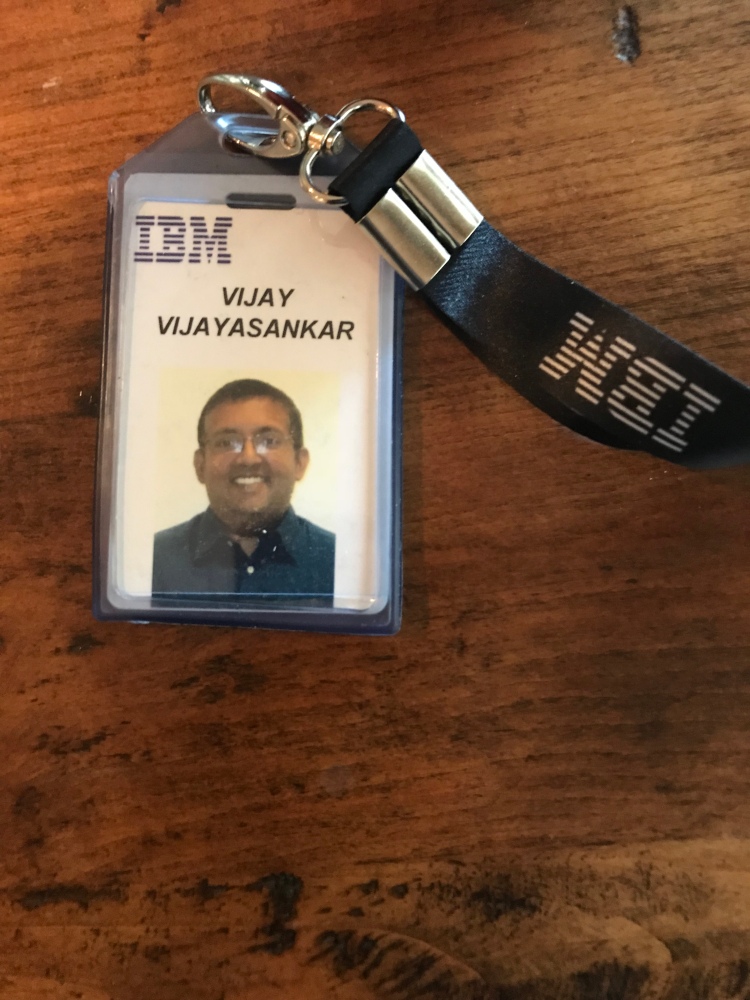
I was in the IBM learning center in Armonk, NY this week for a leadership training class called RISE .

IBM training events are usually quite good – and I have taken and taught at many of them over the years.

But this one was quite special – and I learned a few things that I perhaps haven’t paid enough attention so far .

1. Simulations are such a great learning tool !

We worked in teams of six making decisions about a certain problem . The case study was about 80 pages long that we had to glean info from in an hour . And then every day we got new information and had to tweak our decisions and make new ones. Case studies of course are not new to me and I did my fair share in business school and also in many later training sessions. I have also worked with simulation based systems in past a couple of times . But a three day session – competing against three other teams – and seeing the results of our decisions quickly ( sometimes painfully ) was an exceptional learning experience.

For those keeping score – our team “aurora” won πŸ™‚

2. The power of the Balance sheet !

I had taken the role of CFO for my team . Good thing that the course had a Pre-req to brush up on Finance fundamentals – and I had plenty of time to do it because of the jet lag keeping me awake at night πŸ™‚

In my day job – I worry about P&L every day and cash flow fairly frequently too . It’s very rare that I even have to think about balance sheet . But as we worked through the course of the three days – I quickly realized what a powerful tool Balance sheet can be .

Let’s just say a lot of lessons from my Finance management professors flashed across my mind in rapid fashion πŸ™‚

I think one of the reasons we won the “game” was that we used Balance sheet more productively than other teams. And we strategically kept quiet about that till the end of course πŸ™‚

3. The incredible value of diverse opinions

We had four ladies in the team and two gents . Two from US , one from Hongkong , one from Australia , one from India and one from Belgium . In short – a fairly diverse team .

One decision we had to take quickly in the simulation was to pick a sales channel for a scenario amongst three choices . Five of us chose one channel and my Belgian friend Sonia chose another – and she gave a darn good logical reason . We went with the majority decision and painfully realized as we saw the results that we were dead wrong and she was right !

Good lesson learned to listen more closely and watch for group think kicking in !

I still can’t believe we passed on her perfectly good and rational argument – and I was one of the first to dismiss it . On the bright side – we quickly realized our folly and started listening to each other more intensely since that moment !

4. Hearing the views of multiple senior leaders on the same issues is enlightening

We were incredibly fortunate to have a half dozen senior leaders engage with our class – including my own boss Marianne and my ex-boss Mark ! It’s not often that we get several of them to give their opinions on any given topic . It was an eye opening – and thoroughly enjoyable – experience as they patiently explained their unique views on the questions we raised .

5. “Collabagility” is a thing πŸ™‚

We had some fun with the word – a combination of collaboration and agility . We even created some rap music on it yesterday πŸ™‚

We all thrive on problem solving – and usually that is all from scratch . Over the last four days over meals and drinks together with my new friends from around the globe – one thing became quite clear . Many things that I have encountered as unique problems have already been faced and solved by others across the world. And no one has any issue discussing how they solved those problems either .

I thought I was a well networked guy – but I clearly haven’t done nearly enough in making use of it productively . Now that we all know each other better – I look forward to more “collabagility” πŸ™‚

6. Good decision making needs food , sleep and exercise

Ok – so this I knew very well before I landed in Armonk πŸ™‚ . But for good measure – the faculty reminded me of this any way during the coursework as well .

Just that I first hand experienced what happens when Jetlag plays spoil sport . Day 1 – slept 3 hours . Day 2 – slept 10 hours . Day 3 – slept 4 hours . Day 4 – slept 9 hours . The only good thing that happened with insomnia is that I took some long walks early in the morning – and in biting cold – along the West Chester woods .

There used to be a time when I could run SAP go-lives for 36 hour shifts across several sites. Clearly I won’t be a good release manger any more πŸ™‚