Over the last few weeks , a lot of discussions happened on BI between me and some friends . Essentially – why is it that BI projects seem to stay the same way it was always done even while tools became a lot better ?
To begin with – tools have become better , but not to the level where a user can use it in self service fashion in most cases . So, education is probably the number one issue in the context of BI. Education comes in many flavors – and the easiest one in my mind for a user is the actual tool training . So lets move past that.
There are a few things that have not changed from a BI project POV in several years
1. Users do not understand the data available to them
This needs a lot of bottom up and top down effort to fix . I think top down governance will hit a wall sooner than most of us estimate . Data needs to be explained for each user with real life examples, but that approach is hardly scalable.
BI project plans need to budget time and resources to fix this – but having seen no change in many years , I guess the inertia is just too much
2. Users do not understand what reports are telling them , and most of them have limitations in explaining requirements to IT or consultants
I have done elementary statistics type classes to explain data to users in some past projects . I have a feeling this needs a deeper look to see if such an approach needs to be standard in BI project life cycle.
Users have unrealistic expectations of BI in many cases. This movie is now playing again with predictive Analytics . I see a lot of users and consultants having limited idea of what a predictive model is telling them and what it’s limitations are . No wonder several of them crash and burn .
3. IT and consultants takes a one size fits all approach for BI , and spends little effort in acknowledging BI is personal , not generic
This won’t change till BI is no longer treated as a side kick for ERP . People personalize ERP quite a bit ( at least compared to BI) , and that rigor needs to get into more BI projects .
There are a dozen more things , but I feel better already after typing 3 to get it off my chest
Sorry – had to rant . Will try to not do this too often .
I have been talking to customers on BW on Hana for a good while now – about their plans to make use of BW on Hana, and what roadblocks exist for its adoption etc. Here are the top three concerns that I hear the most
1. Projects to migrate to BW take a long time to complete, delaying value realized by business
2. Due to the length of the project and the cost to acquire HW, SW and Consulting services – the initial investment to be made looks high for some customers
3. Is it possible to try a few scenarios in BW on Hana quickly before going all in with a full migration?
Last year, several customers asked me why they should consider BW on Hana. These days, I hardly hear that question – I get more questions on “HOW” they should go about it . And to help customers and partners with this , my team and I have been traveling across the world doing hands on sessions on BW on Hana as well as BI on BWoH. Several other teams at SAP have also been doing similar enablement sessions, so I think the “HOW” part will be adequately taken care of too.
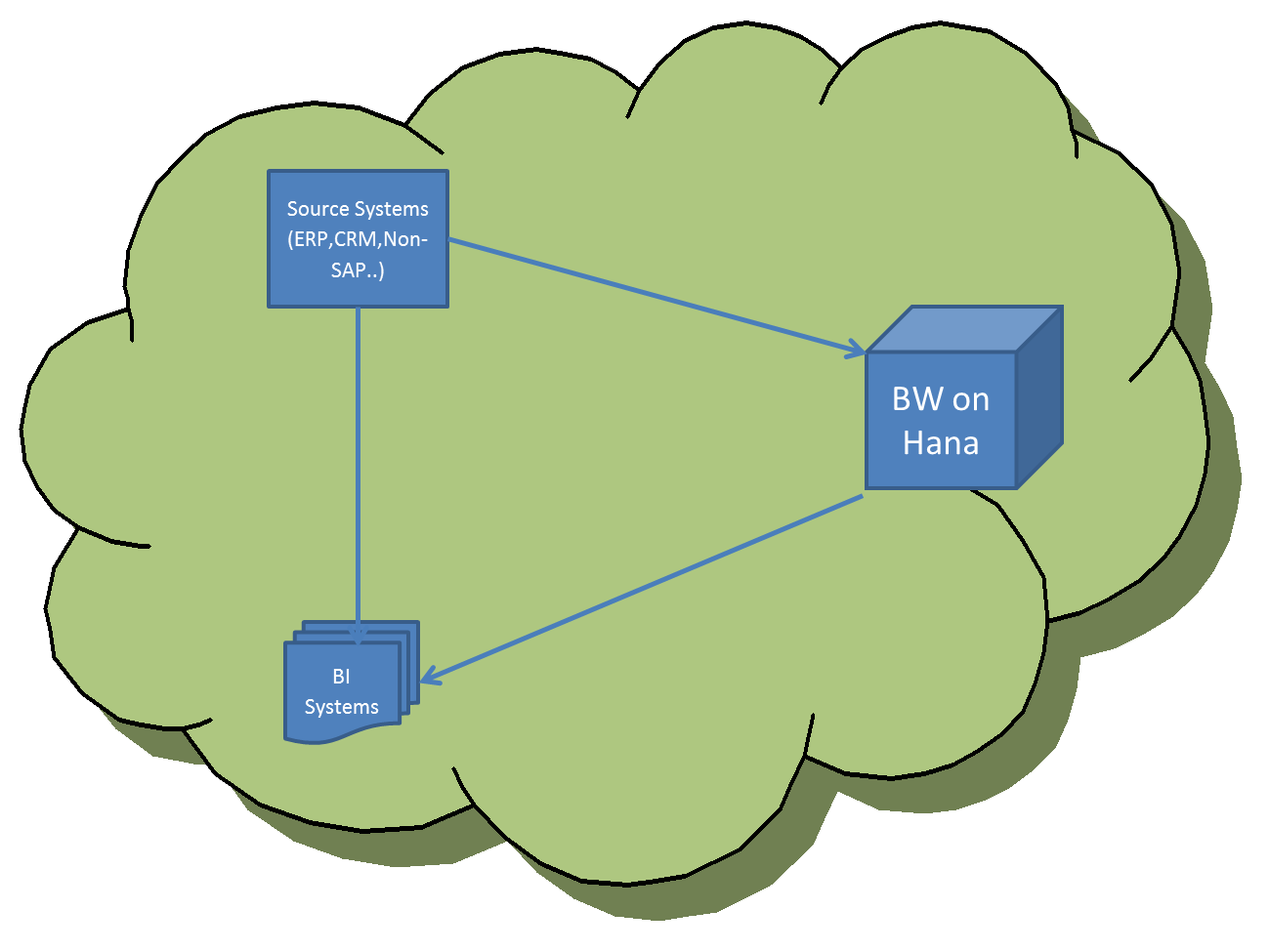
But we still need to better address the 2 questions on length of migration projects as well as the initial cost. And this why I wanted to ask your opinion of putting BW on Hana on cloud, on a subscription basis. There are many potential deployment options like I scribbled in these pictures on what systems can move to cloud.
I I really have no idea whether SAP can actually do any of these ( it needs to make sense on technical and business dimensions). So please do not treat this as an official SAP statement. My intention is strictly to present my thought process to the ecosystem and get some feedback from all of you. And of course , this is just an “additional” deployment option, not a replacement of on premises BW on Hana which I fully expect to continue.
Back to the 2 common concerns – how do we solve that? I think a cloud option is probably one worth considering. Here is what I think might work
1. SAP or a Partner acts as the cloud provider and signs a subscription contract with customer via SAP Hana Marketplace
2. Customer gives a copy of current BW system to the provider
3. Provider imports and migrates the copy into their cloud, and does testing. Maybe customer can do some user testing too.
4. With necessary signoffs, the solution is cut over into a productive instance on a cloud that customer can access
5. Any extra data/ transports etc that are needed are applied, deltas initialized, BI tools connected etc
6. Customer starts using the productive instance of BW on Hana with some agreed up on SLA
7. Customer starts paying the monthly subscription, with some provisions for data growth, additional BI clients and so on in future
I probably made it sound simpler than it is – but hopefully the general idea is clearly coming across to you.
I think there are many advantages in the cloud model
1. Customer deals with one provider alone – not one each for HW, SW, Consulting and Support.
2. Since one provider has full control over end to end experience on multiple customers – economies of scale should kick in and result in less time to do migration, and less cost than customer doing all the steps individually via multiple partners.
3. With subscription pricing, there is no big initial outlay for customers . Monthly payments are predictable for budgeting reasons etc .
Of course there are some trade offs too that need to be considered
1. There might be some reluctance to move a data warehouse to cloud for fear of security. However, this reluctance is definitely coming down – and VPN and other security measures can be put in place .
2. Network can become a constraint for loading and reporting. However, given the speed of BW on Hana on both reporting and loading are faster than classic BW, some of this can definitely be compensated. Also, not all loads are real time into BW . There is of course the option of moving the source systems also into the same cloud and reap even more benefits.
Now the million dollar question(s) – what do you folks think about this? Do you think this will help more customers derive value from BW on Hana ? What other factors should be considered from the customer’s perspective ?
And about the third concern of how to get a jump start on BW on Hana without going all in – Do you think customers will like to get a Hana One Premium type system for BWoH that they can run in parallel with existing BW systems for just a few scenarios ?
Lets discuss here in the comments section, and pls fill out the polls below
I ran into an ex-colleague of mine at a restaurant recently, and it was a lot of fun catching up. It was not the best of times for him – after doing the first half of a project successfully on time and on budget, his customer gave the second half of the project to a low cost competitor. He was at the restaurant for a final lunch with his project team, and that is when I ran into him.
His boss was my boss too – and someone who I still treat as my mentor. So I asked about how he was doing. My friend burst out laughing – and told me about the conversation he and the customer CIO had before he left for lunch.
Apparently, his boss met with the CIO after he was told that his firm lost the business. The CIO totally expected him to push hard to reconsider the decision – which is the routine thing to do for vendors who lose consulting business. However, this time – that is not how it transpired. My ex-boss didn’t say anything about the lost business – nothing at all. Instead , he told the CIO – “Remember I told you we should celebrate your go live big time? Right now I am going to reserve the best restaurant in Napa for us to go celebrate the day after your go live next year. Nothing is more important to me than your success” . That was it – no push for business, no bitterness, nada. Even more striking is that this deal being lost put his quarterly targets at serious risk.
Knowing this guy over the years, I wasn’t surprised one bit when i heard this and knew why my friend was in good humor recounting the conversation to me. We were both equally in awe of the guy. That is how he operates – he knows that a genuine relationship is timeless, unlike transactions that he might win or lose today. Given his success rate on big deals is more than 80% of the time as I remember, I believe that is a successful strategy.
It is a lesson he has tried to teach me and everyone else that he mentors – and shame on me, I have not mastered it yet. But this story was enough to help me get back on track and keep the long term in mind, no matter what. I thought I will share this with you folks too in hopes that it might help inspire some of you, like it did for yours truly.


 And Vijay Says...