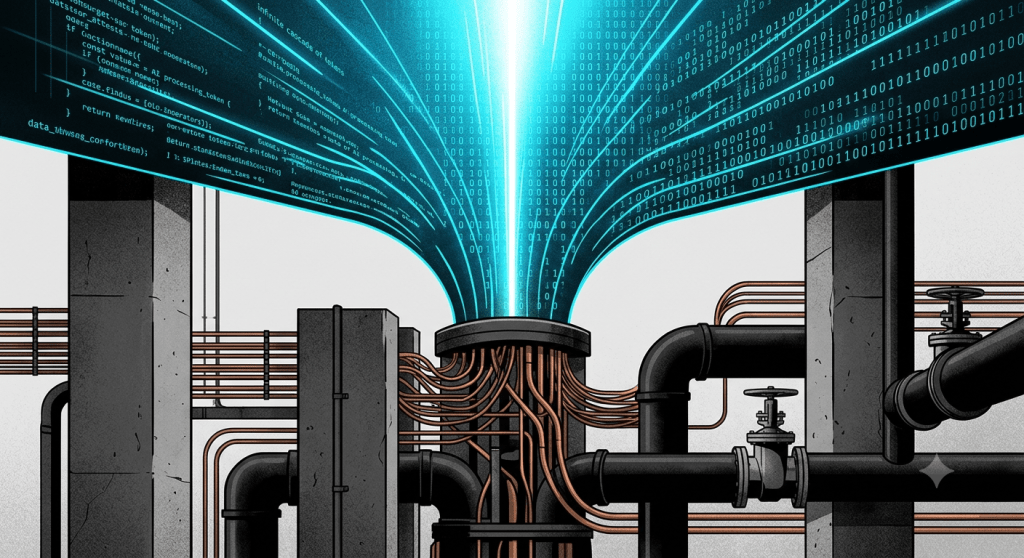
Every technological revolution creates abundance. Every economic revolution begins with a shortage.
This is the central paradox of progress. When a technological breakthrough occurs, our instinct is to gaze directly into the light of the explosion. We celebrate the elimination of a historic limitation. We conclude that the world has changed because what was once expensive and difficult has become cheap and ubiquitous.
But abundance does not automatically generate economic value. It frequently destroys it.
When a breakthrough makes a previously scarce resource abundant, the price of that resource collapses toward its marginal cost of production. Persistent economic rents do not pool in the sea of abundance. They accumulate around scarce constraints.
Every technological revolution creates two simultaneous stories. The first is the story of abundance. It dominates public attention because breakthroughs are highly visible. The second is the story of migration. It determines where enduring economic value accumulates because constraints are less visible.
The true economic revolution begins only when we look away from the breakthrough and start looking for the new shortage it has created. Technology does not eliminate constraints. It changes the architecture of constraints.
I. The Engine of Friction
To understand why this cycle repeats, we have to look at the foundational physics of operations. In his 1984 classic The Goal, Eliyahu Goldratt codified the Theory of Constraints, proving that any complex system has exactly one bottleneck that dictates its total throughput. What was true for twentieth-century manufacturing plants is now scaling exponentially across twenty-first-century digital ecosystems. Technology doesn’t eliminate Goldratt’s law. It simply accelerates the speed at which the bottleneck moves.
No business, industry, or economy is a single machine. It is a chain of connected steps operating at different speeds. Because the throughput of the entire chain is determined by the slowest necessary link, every system always has a limiting factor.
Eliminate one bottleneck, and the pressure instantly shifts to the next one. A constraint is not a glitch or a temporary market failure. It is the unavoidable reality of any interconnected operation.
At any given moment, the speed of an entire industry is dictated by this single element: the binding constraint. It is the anchor that determines the capability, speed, and profit margins of an era.
Historically, we have defined our major industrial shifts by the nature of these anchors. For centuries, the binding constraint of human productivity was raw muscle power. Then came steam and electrification, which made energy cheap and abundant. Suddenly, the bottleneck was no longer the ability to generate force, but the ability to coordinate parts. The binding constraint shifted from power to the physical layout of the factory floor.
More recently, we spent decades constrained by the speed and cost of moving data. Digital networks made distribution abundant and essentially free. The moment information became abundant, the binding constraint migrated to human attention and synthesis.
The illusion of the breakthrough is believing that solving the old constraint is the end of the journey. In reality, it is merely the opening of a new theater of scarcity.
II. The Factory Floor Reality
Consider a simple assembly line. If a factory has three stations—Station A produces 100 units an hour, Station B produces 10 units an hour, and Station C processes 50 units an hour—the total output of the factory is exactly 10 units an hour. Station B is the binding constraint.
Now imagine an inventor arrives with a miraculous machine that allows Station A to produce 1,000 units an hour. The temptation is to celebrate the infinite capacity of Station A. Investors pour capital into optimizing it even further.
But what is the actual output of the factory?
It remains exactly 10 units an hour.
In fact, making Station A ten times faster creates a crisis. Inventory piles up in front of Station B. The system becomes choked, chaotic, and inefficient. The abundance at Station A has not solved the factory’s problem. It has magnified the shortage at Station B.
An optimization made anywhere other than the bottleneck is an illusion.
When a technological revolution introduces radical abundance into an environment, it behaves exactly like that miraculous machine at Station A. It accelerates one part of the system to near-infinite speed. In doing so, it exposes the structural friction, institutional inertia, and physical limitations everywhere else. The binding constraint moves, and it moves with brutal clarity.
III. The Token Paradox
We are watching this exact pattern unfold at the software layer of the AI race. Over a remarkably brief window, architectural breakthroughs, open-source competition, and intense model distillation have cratered the cost of base intelligence. Based on published frontier-model API pricing benchmarks, the cost of standard foundation capabilities has collapsed from an early 2023 baseline of roughly $20 per million tokens down to fractions of a cent on modern value-tier endpoints. Raw text generation and basic reasoning have entered the sea of abundance, racing toward their marginal cost of production.
Yet, as the unit price of intelligence drops, enterprise AI budgets are expanding rather than contracting. This is not a contradiction; it is a volume explosion driven by a fundamental shift in architecture. As organizations move past single-turn chat interfaces, they are deploying autonomous, agentic workflows that consume millions of tokens to execute complex business processes.
According to the Menlo Ventures 2025 Enterprise GenAI Report, enterprise generative AI spend surged 3.2x over a single twelve-month cycle, climbing from $11.5 billion to $37 billion. This massive deployment of capital is scaling off an entirely new baseline budget. Longitudinal tracking from Andreessen Horowitz’s Enterprise AI Buyer Surveys across sequential waves charts this compounding expansion clearly: an initial survey wave recorded an expected 75% growth in GenAI budgets, which has since transitioned into an additional 65% year-over-year projected increase as average corporate allocations scaled up from $4.5 million to $7 million per enterprise.
Crucially, the massive influx of capital has completely altered how corporate buyers approach the technology stack. In 2024, corporate adoption was split roughly down the middle between building internal custom scaffolding and purchasing external platforms. Today, Menlo Ventures data reveals that 76% of enterprise AI use cases are purchased rather than built in-house.
Enterprises are shifting away from internal builds because cheap intelligence has not eliminated the enterprise bottleneck. It has exposed a new one, moving the binding constraint from intelligence generation to verification and trust. As I argued recently in The End of the Model Bet, an enterprise strategy built primarily on access to increasingly commoditized foundation tiers is becoming progressively less durable.
When an agent can generate thousands of lines of code or process exhaustive corporate document queues for pennies, the scarce resource is no longer raw output. It is confidence. Enterprises need deep structural ways to prove that AI-generated actions will not break production systems, violate regulations, leak sensitive data, or confidently fabricate errors.
Consequently, economic value is migrating rapidly away from the commoditized model layer toward enterprise orchestration, data governance, evaluation, and deep verification systems. The new scarcity is certainty.
IV. The Infrastructure Wall
The same mechanism is simultaneously reshaping the physical layer of AI.
For years, the strategic bottleneck was a shortage of advanced silicon. Capital rushed to solve it, and technology companies committed hundreds of billions of dollars to expanding compute capacity.
As compute capacity grows, the next binding constraints are increasingly power availability, grid interconnection, cooling, and data center capacity. The abundance of compute has not eliminated the scaling problem. It has transferred the pressure to the physical infrastructure required to operate that compute.
We are already seeing market capital follow those constraints. Investment is surging toward firm energy infrastructure, on-site power generation, grid upgrades, and specialized cooling technologies.
Crucially, the primary constraint here is no longer a lack of capital or interest—it is the grinding reality of institutional and physical queues. Data compiled by the Lawrence Berkeley National Laboratory (LBNL) Interconnection Queues Tracking reveals that the U.S. transmission queue remains historically gridlocked at over 2,000 gigawatts of active capacity. While a massive wave of unviable, speculative projects withdrew after facing escalating study costs, the viable infrastructure projects that remain face a median duration approaching five years to move from initial request to full commercial operation. The bottleneck has entirely shifted from the factory producing chips to the infrastructure clearing the grid.
This dynamic follows the historical script of industrial scaling. The shipping container made transoceanic transport radically cheaper, faster, and more predictable. The binding constraint shifted away from loading cargo onto ships and toward port infrastructure, logistics coordination, and warehouse networks. Over time, ocean freight became increasingly commoditized while value accumulated around the new constraints.
When value migrates, incumbents often fall into a capital allocation trap. They continue investing in yesterday’s advantage long after the market has stopped assigning it a premium. They mistake growing output for enduring value.
V. The Strategic Diagnostic: Mapping the Next Scarcity
For leaders building agentic enterprises, this framework is more than an explanatory lens. It must function as an active capital allocation tool. When designing an automation roadmap, leaders must subject every technical deployment to a rigorous three-step constraint audit:
- What scarcity are we eliminating? Which historically expensive or slow capability is about to become abundant and practically free? (e.g., massive-scale financial invoice reconciliation, customer inquiry triage, or rapid application code generation).
- Where does the bottleneck move next? Once that capability becomes effectively unlimited, where will work begin to queue instead? If an autonomous system can process 50,000 complex validation events an hour instead of 5, the new constraint is no longer production speed—it is the exception-handling capacity of human operators or the automated multi-party dispute verification engines required to act safely on those outputs.
- Are we investing in the new constraint? Stop over-investing in the dissolved anchor. Shift enterprise budgets away from basic model access and redirect capital toward building the proprietary workflows, guardrails, and automated validation layers surrounding the secondary bottleneck.
If you optimize the system anywhere other than the newly exposed constraint, you are wasting capital to build an inventory pile-up.
VI. The Cost of Adaptation Lag
Why is this reality so difficult for leaders to act upon?
Because technology scales exponentially while institutions scale linearly. A technological breakthrough can happen within a year. Reorganizing companies, incentives, regulations, talent, and operating models to absorb that breakthrough can take a decade.
That gap is adaptation lag.
During this period, organizations use new technology to execute old processes. They bolt AI onto legacy workflows. They use a jet engine to pull a covered wagon.
Changing technology is relatively easy. Changing institutions is extraordinarily difficult. It requires redesigning incentives, operating models, governance, skills, and organizational architecture. This is closely related to the core premise of The Last Proprietary Advantage: as transient technical advantages erode, enduring corporate differentiation shifts entirely toward how organizations are wired to execute.
As a result, the binding constraint eventually ceases to be technical. It becomes institutional. The shortage is no longer capability; it is institutional capacity to absorb abundance safely and effectively.
The Core Synthesis
The central insight is simple. Technological breakthroughs systematically reconfigure the architecture of constraints. Because capital and institutions adapt more slowly than technology, enduring economic advantage migrates toward the newly binding constraints.
You do not need to predict the precise technical specifications of the next breakthrough to understand where value will emerge. You only need to identify today’s binding constraint, understand what abundance is about to dissolve it, and ask where the pressure will move next.
Every technological revolution begins by answering one question.
Not: What became abundant?
But: What became scarce because of that abundance?
Every generation mistakes the breakthrough for the destination. It never is. The breakthrough simply changes where scarcity lives.
The companies that keep investing in yesterday’s scarcity become yesterday’s winners. The companies that discover tomorrow’s scarcity build the next era.
That is where enduring advantage will be found.

