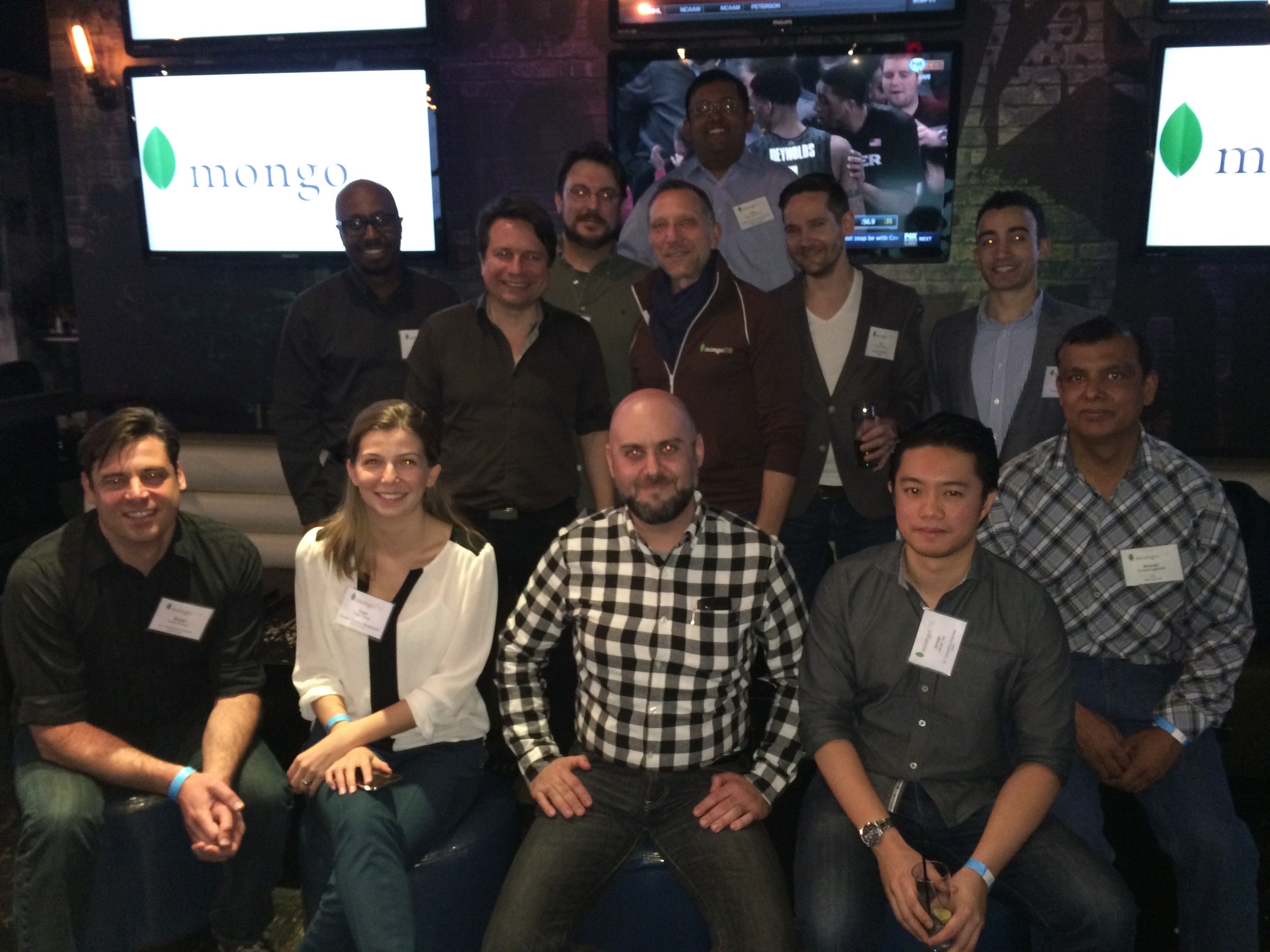
So long MongoDB, and thanks for all the fish !


April 15, 2015 proved to have quite a trifecta effect on me

1. Tax day – As always, IRS have taken their annual pound of flesh from my checking account

2. Vishu – a traditional festival of my home state of Kerala, marking the start of zodiac calendar

3. Announcement that I will be leaving MongoDB by the end of April

IMG_5701

MongoDB is an amazing technology – and it is of course a successful company with a lot of money in the bank and a lot of customers and users. But none of that is its secret sauce – it is the people in this company that makes it a very special place. We have an extraordinary high quality of talent in the employee base. That is also the part that makes leaving MongoDB quite painful for me.

Max Schireson, who was the CEO at the time, hired me into MongoDB on April fool’s day last year – and it has been quite the ride since then.

I started here as the VP of Global Channels (even played a prank on last April 1st that I am joining as VP of social media, and some folks believed it too ). A couple of months later, I also took over business development function as well and then Global services got added to my portfolio when Dev Ittycheria took over as CEO . Each one was a unique challenge, but I was fortunate to have a team that considered no mountain high enough for us to take. Long story short – we had a blast and the results speak for themselves . I am proud of what the channels and services teams have accomplished and I will be cheering for them as they meet and exceed even bigger goals in future.

20140626-101724-37044331.jpg

I have no doubts that MongoDB will be a hugely successful product and company. There are many possible routes to that success – and Dev and I have two rather different approaches we feel are best for the company to get there. We discussed this at length, and eventually we mutually agreed that it makes sense for me to leave by end of this month after finishing our first quarter. I wish Dev, the leadership team and the board the very best, and look forward to celebrating their success .

The biggest thanks I owe today is to my executive assistant , Kaila Hecht. Without Kaila’s skills managing my schedule (and travel, expenses and a hundred other things) – I would honestly not have done very much productively in my time at MongoDB. I don’t know how she does it given my insane schedule – but she is a wizard (and its her first time being an EA ) and she is the most pleasant person one could meet. Thanks for everything Kaila. I will be blessed to find another assistant like you . You will go places. I should also say a big thanks to Eimear McVeigh who has always found me time with Dev any time I asked.

IMG_5535

One of the things that make me super thrilled on my way out is that the person taking over the leadership of Global Services is my dear friend Richard Kreuter. He is a consultant’s consultant and is one of the most fun people in MongoDB. If anyone can beat me in competitive sarcasm, that would be him too. Services at MongoDB is just getting started – Richard will take it to much greater heights. Not only does he have an amazing team of consultants ( it will be a challenge to keep recruiting A+ players like we have been doing – but I am sure that is how it will happen going forward too) , he has a world class ops team with Ozge, Andrea, Jackie and Chuen. The only way for services team is upward !

IMG_5534

One of the things that I have not done very well in past jobs is having strong women leaders in my team – and I am incredibly lucky to have two amazing women leaders in my team now as my direct reports. Ozge Tuncel is our director of business operations, and Sheena Badani is our director of tech alliances. Ozge is a Wharton MBA and Sheena is a Harvard MBA – and both schools should be incredibly proud of these two young ladies as their alumni. Now I am firmly convinced that I will recruit and develop more women leaders in my team in future.

When I think about our channel leaders, the word that comes to mind is “variety”. There is nothing in common at first glance between Ravi, Robert, Gullaume and Rajiv. Each is a unique character with high level of skills – and yet magically they all work together to consistently nurture the vast ecosystem of partners. I would be remiss if I did not thank the colleagues who left the team – Luca, Koby, JP, Adam, Brendan, Heather and many others who all played a part in getting the team to where it is today.

Then there are our technology magicians – the partner tech services engineers who made things actually happen on the system and explained concepts clearly to our partners. Edouard, Joe, Buzz, Tug , Aveek – you guys are awesome and I owe you a lot of beer still !

There are way too many teams and individuals to thank by taking names – so I am not going to try doing that. You know who you are – and please know that its been my honor and such a privilege knowing you. I will gladly go to battle any day with you on my side .

Last but not certainly not the least – a special thanks to all the partners and customers that make MongoDB successful. Many of them are folks I have done business with in past – and I hope to continue the relationship in future too.

So what is next for me ?

I honestly do not know. Once Dev and I took the decision, I reached out to a handful of my friends and mentors to let them know . And that has resulted in a few good conversations with potential employers these past few days. I must admit that the thought of starting something on my own – within IT, or may be something more fun like my dream Indian Restaurant – has also crossed my mind. Only time will tell how all this will play out and where I will end up with my next adventure.

But first I have a couple of weeks left at MongoDB to wrap things up. And then hopefully I can get a bit of a time out before starting the next chapter of my career. There is a lot of sleep, family time, reading and music to catchup – and hopefully I can personally show my young dog in person at a dog show finally.  I will keep you posted .  Wish me luck !


Recruitment Does Not Have To Suck


Many of you know that I hold a strong view that nothing is as broken in HR like recruiting ( close call with performance appraisals for the cake) . I am not talking about the technology behind it – just the process and people that are involved . But it doesn’t have to be that way – And having been recruited the right and wrong way, and having recruited several folks over the years I have led teams , I thought I will share some thoughts .

I have no problems confessing that I mess up with this all the time – but it is also one of the areas where I consciously try to improve every time.

1. Own it – no excuses 

If you are the one who needs people in your team , then it is your responsibility to find them, evaluate them and bring them onboard in a way that makes it pleasant . This is one job where delegation is generally a bad idea .

At executive level – this takes even more importance and has personal impact. When MongoDB recruited me – Max Schireson who was the CEO, did the entire process himself and that played a big part in me forming a good impression about the company. Our current CEO Dev is also very deeply involved in recruitment.

I always like peer interviews. In most jobs, people need to work across teams where the only lever you have is your ability to influence. if you don’t feel comfortable with your peers, you will struggle and do a sub par job. When managers don’t use peer interviews, I encourage candidates to ask for it.

2. Recruitment never ends

Always be recruiting and encourage your team to be recruiting and reward them for doing it well (goes without saying – potential for carrots also mean sticks for doing a bad job) . There is always a tactical part of a head count plan – how many can you afford in a period of time . News flash – Screw that ! You always need a pipeline of candidates kept warm.

Time will pass , someone will leave your team , requirements will change and there is always budget to make more money for the company . If you aren’t constantly recruiting – you will miss out on a lot of opportunities .

3. You own the recruitment for managers directly working for you too

If you are a regional VP and have sales directors under you who in turn hire reps that actually sell – guess what , you own responsibility for hiring the best reps too . You need to do it in a way that your directors feel that you are helping and not getting in their way . As you become a third line manager – this becomes harder – but you should absolutely involve yourself in key hiring decisions. The vision is yours and so is the responsibility for execution. It frustrates me endlessly when executives forget about the execution part and only care about strategy/vision. And recruitment usually proves that point one way or other.

4. Talk about money early

Money may not be everything – but in general, good people cost good money . And if you drag them through a process only to tell them at the end that you can’t afford them – you will piss them off totally and you have lost them for good . You might need these people in future for another role . Get a ball park amount upfront and don’t drag candidates to a brick wall if you can’t make it work . I wish more candidates were upfront too about this too early in the process.

Recruitment is mostly about cost today – shift the conversation to value (same as in sales) and then both sides will make an easier and better decision .

5. Recruiters are invaluable – use them well

Recruiters get a bad reputation when hiring managers are lazy or incompetent – that is unfair. Good recruiters push back on managers to get a lot of information upfront . They won’t post generic job descriptions to begin with . Spend time with recruiters and explain your vision for your business and what the new candidates are supposed to do when they join . Let them listen in when you talk to a few candidates so that they see first hand how to pitch the job themselves to the next candidate . Take recruiter’s help in fine tuning the hiring process – just don’t delegate responsibility to them and be hands off.

That said – there are plenty of bad recruiters out there too . Many treat it as a chore and focus on developing skills only for volume recruiting . Avoid them – and you can thank me later. Money spent on a good external recruiter is totally a great investment. Choose them wisely.

6. Recruitment is not about gotcha questions 

The easiest thing to do in an interview is to make a candidate sweat and irritated . Some will take it well but many will tune out and think you are a jerk . Remember that the good candidates treat these sessions as their own evaluation of the company – and if you fail them , you are the loser . Ask hard questions by all means, but help provide context and evaluate how they think through it . The thought process is more important than the final answer. And always thank people for taking the time to consider your team. Remember that they form lasting impressions with every such interaction.

Just for kicks, I just remembered a job interview as a young engineer. I once interviewed for a consulting job where a really hard math problem was given to me to solve. I knew the answer and told the interviewer that I know the answer from before. She gave me an even harder one that I could not solve and she just kicked me out without even a thank you or an acknowledgement of me being honest . That same company later tried to recruit me multiple times as an executive, and I won’t even answer their calls. I totally know that I am not being very mature about it – but that is what happens when you get imprinted with these things at a young age 🙂

7. Do at least some of the reference checks yourself 

The one hour you spend with candidates in person doesn’t really prove anything much  . You need to be better at reference checks for that. This is especially important for senior hires . Also, your chance of getting specific answers is a lot higher if you call them directly as opposed to a recruiter calling on your behalf . If a recruiter is calling – make sure you have given the recruiter enough ammo for the conversation .

8. Be flexible in job requirements

Front line people almost always need deep and specific skills , but managers need versatility . Hire accordingly .

A rep who has closed 200% of her quota every year doesn’t always make a great sales manager . And a rep who barely managed to beat quota might make a fantastic sales manager . As a rep, it is good to be selfish and treat all available resources in a company as yours to close your deal. This same trait is absolutely horrible in a manager who should be balancing all resource needs across the patch.

Focusing on their last job too much is a fault  that I have made myself a lot when I recruited earlier in my career . Now I have no hesitation hiring atypical candidates for managerial roles as long as I know there is a support system in place for providing specific skills they lack . I value utility players  – as your team grows , you need your leaders to pinch hit in a variety of roles . Don’t hire a lot of people with no potential to grow laterally .

In very large companies – you could craft a new role for what a unique candidate brings to the table . That is harder in a small company – but in any team , you can have some flexibility to switch around requirements when you find awesome talent.

9. Differentiate between long term and short term hires

Some times you only need someone for a short amount of time . Say you are a startup that needs someone to run finance. You should set up the expectation while recruiting that you are looking for a VP and not a CFO. Don’t let it become a scenario where the person who hire assumes that he will be CFO automatically in two years. Sounds simple – but I have seen tens of horror stories in last year alone . This is how leaders earn a bad reputation for a long time – when everyone in the industry gets to hear about you as “bait and switch” person.

You don’t have to assume that good people won’t come to your team unless you give them a life time career . World has changed – deal with it.

10. Treat internal candidates fairly when recruiting 

This one is really hard -you know their skill gaps more than you know the gaps of your external candidates . Resist the temptation as much as you can to amplify the virtues of external candidates and minimize internal candidates . It needs a very honest conversation – and it is really hard to not reduce the motivation of existing team if you don’t communicate well. I have failed this aspect many times myself . It is easy to know when you have messed this up – performance of the internal candidates drop , or they will leave your team. Some times it cascades to others in your team too in the process. Guess who lost ? You did !

11. Do your homework on the job and the candidate

A simple google search will tell you a lot about the candidate. Yet – I first hand know many managers who do not know anything about the candidate when they interview them. This might be a good thing for the candidate who has done their research on the company and the interviewer – the side with more information tends to have advantages. There are also people who have not read the job description before interviewing candidates. If I am a candidate, it will take a lot to convince me that this is a company I want to work for if the interviewer appears clueless about the position. So if you are enlisting the help of others to interview someone – please take the time to brief with them before the interview, and not just afterwards.

12. Parting thoughts…use of analytics

I do think these days that using analytics to help recruit is a great way to do it. Plenty has been said about it by HR Technology vendors and analysts – and it has captured my imagination in a really big way. However, I very rarely see it happen in a significant and scalable way in real life. For that matter even rudimentary reporting is a struggle in HR. I grew up in BI – and it has always amazed me that the people who have given me the least complex requirements are the HR managers. I am counting on this getting solved real soon, given some of the sharpest brains I know are working on making this work.

Big data opportunities and challenges are getting a bit clearer


From time to time, I take a few days off work to reflect on things I don’t get to think about in “regulation time” . Its a bit of spring cleaning of my mind.

IMG_5641

I am in the middle of one such break today. Other than sleeping a lot, and recovering from India’s loss to Australia last week in cricket world cup – I have been busy reading, listening to Ilayaraja songs non-stop, installing a new patio door, following the progress of my dog who is on a dogshow circuit in midwest with his handler (probably the closest to a good training for me and my wife for when our kiddo leaves for college) , catching up with my friends/mentors/old customers/school mates etc.

Yesterday night, I finally put an end to my month long misery of not being able to crack the 2048 game ( it is a super addictive game – my advice is to not start on it unless you don’t mind spending every spare minute on your phone playing it, and it is a big culprit on the battery drain front). The first thing I did after getting the 2048 tile was to take a screenshot to show my daughter who challenged me to do it, and the next thing I did was to delete the game on my phone. All of today, I have been fighting the withdrawal . As of 5 PM PST, I can report that I could resist the temptation of not downloading the game again and playing it all over again 🙂

Spending the time talking shop with all the peeps I managed to get a hold of these last few days – one thing hit me immediately. Customers and vendors who have started on their big data journey in the last year or two have a new appreciation for the opportunities and challenges in front of them. The opportunity part is pretty straightforward – customers are recognizing that some of the hype around big data is justified, and that real verifiable customer stories are now available. Of course they also know the koolaid firehose is still running full 🙂

Here are some recurring themes on the challenges.

1. Talent shortage

Vendors need technical pre-sales people and developers the most. Customers need developers and ops people either in house or from consulting companies. And such people are apparently in unicorn category. And when these people are available – the employers just don’t know how to evaluate their skills.

Another issue that customers seem to be running into is breadth vs depth. They can usually find an expert in one technology for the right money. But a project typically needs more than one new technology – like maybe hive, mongodb and say elastic search. People who can integrate all of them in real life are rarer than unicorns in rainbow color.

2. How exactly does open source work ?

The people who understand the nuances of open source are overwhelmingly on the vendor side of the house. This includes legal experts. Some customers are also finding their trusted buyer’s agents are not yet smart on open source models. There is some silver lining though – Subscription models are better understood compared to a year or two ago.

3. Procurement cannot figure out what motivates sales people any more.

This one made me smile quite a bit. A good part of my grey hair can be attributed directly to wrestling with procurement folks over the years. Here is how one guy explained it to me ” It was pretty simple in the past – the larger the check I could write, the more benefits I could extract from the salesman. It no longer seems to be the case across the board. Sales reps selling BI and big data things to me all seem to have incentives that are rather unique. Some don’t even want big checks anymore. Some like cloud and some others talk me out of it . I feel like I need to take classes on dealing with them”.

And an IT director buddy – someone who has planned and executed 100s of millions of dollars worth of projects in his career told me “I have a hard time with financial models for projects now given the mix of perpetual and subscription models for all the different software I need. I can barely understand all the pricing and terms nuances , let alone explain the full picture to the controllers and other stakeholders”.  The impact is a weird situation – he takes more time planning a project than actual execution, and he hates it.

4. Development is not the big worry anymore – maintenance is 

They all unanimously agree that these new technologies all reduce development time significantly and give great flexibility to make changes relatively quickly. However, they all have the same worry on maintenance – especially my friends who work in consulting/outsourcing companies. These new technologies all have different security models, different ways to backup and restore and different ways to provision new instances. Each one is built individually to be maintainable and scalable – their worry is how to do all of them together with tight SLAs.

5. Minimal vertical messaging 

I never thought I would hear customers ask for more marketing – but that did happen!  What is the world coming to ? 🙂

These folks have all heard it loud and clear that data is big and bad these days and these new technologies can all help them to tame the bad ass big data beast. But they are looking for specific examples of how it helps customers in their industry. On the bright side most of them are not hesitant to try proof of concepts for new use cases.

I did not offer any solutions to these challenges – my intention was just to listen and get a feel for where we are headed at a big picture level. But now that I have thought about it a little bit, I have some rough initial thoughts on things that can help make life easier on this front. When these thoughts are a little better formed, I will make an attempt to scribble them and share.

I am very curious to hear from all of you on whether these themes are showing up in your big data journey. Let me know !