For the most part, I have had a pretty good career so far – not spectacular by any stretch of imagination , but can't complain either . And I attribute most of it to having great leaders who helped me grow.
My interest in leadership started for a simple (and awkward) reason – in the early part of my career, I had some really awful managers. My solution was to stand up for what was right in my mind and often leave the company as a result. So by the time I was given a leadership role – I was determined that I should not let any one in my team go through the trouble I had in the past. Roughly at the same time – I also had the good fortune to see what great leadership looks like (finally!) and it helped set my expectations more appropriately.
One thing became abundantly clear to me over time – learning how to be a good leader is a journey and never a destination . There are no "here are 12 things to do" that serves as a magic bullet . You need to constantly calibrate where you are and seek the needed help to improve. This unfortunately doesn't mean that I followed through on it – I have some ways to go 🙂
Thanks in a large part to the less than stellar leadership I got when I started out – I have become a big fan of mentoring young men and women who are starting out in their careers. I also spend a lot of my time mentoring first line managers . This serves two purposes – the highest energy comes from the entry level colleagues and I get to channel it for the good of the business , and I don't become a bottleneck to the process since the first line managers get a better perspective on why their success is totally dependent on the success of their team.
To enable this behavior – I have long had a rule that anyone can get 15 mins on my calendar , no questions asked. Not everyone takes me up on it – but several do. And it does get overwhelming at times.
This is when my friend Stephanie Anderson, an HR leader in IBM, gave me some invaluable advice . She told me "You cannot mentor everyone – you need to let others help you". Pretty straightforward and I should have known it – but the truth is that I did not . I am pretty good with delegation – as any of my direct reports can vouch for . But when it comes to mentoring , clearly I sucked at delegation . So thanks to Steph giving me timely feedback – I have woken up to the reality and have started enlisting the help of others to help mentor more of our younger colleagues . Thanks Steph ! And since no good deed should go unpunished , I am now pushing a bunch of mentoring requests to Steph as well 🙂
The first few years of my professional life was actually quite calm – I learned programming and project management and got to apply it at projects and had the time to develop my skills. I did not have to do much more than take classes couple of times a year to stay on top of it . Then it started changing – technology started moving at faster pace and I realized I need to get into a "learning is for all of your life" paradigm . And that has only helped me in my life – actually on personal front too . Folks starting out today don't have the luxury I had of starting slow !
For a long time, I wondered why I was signed up for classes like "executive presentations" and "executive negotiations" when I was not even close to being an executive . But in hindsight – pushing me to take those classes was one of the best things my mentor Ken Englund did for me more than a decade ago. It taught me that the sooner you learn things – even if they are hard and they don't apply immediately to your work – the faster you make an impact . And trying new skills in early part of your career is a lot less risky than trying them later.
So when last fall when our North America managing partner Ismail Amla asked me to sponsor the core consulting school for senior managers , I jumped in with both feet. I still wonder why he chose me given he was fairly new to IBM at the time and we didn't know each other very well at the time . In any case I said yes before he changed his mind 🙂
I was also taking over a new day job running a large ( well large for me, not really that large for IBM) portfolio in parallel . I sure had my moments of stress – but it was the best experience in my time at IBM bar none .
To begin with, I had no idea how much care and effort it takes to put on a comprehensive learning event – and the Pre and post school activities . Fortunately I was paired with experienced learning experts like Debi Steinbacher , Lorraine Rapuano and other colleagues . We also managed to find a team of volunteers from amongst the partners and associate partners in the firm to be the teachers . It's pure magic when a team of passionate people come together with a common purpose – and now Bee School has taken a life of its own and is growing from strength to strength . And here is a shout out to Pooja and Andrea for coming up with the name "Bee School" !
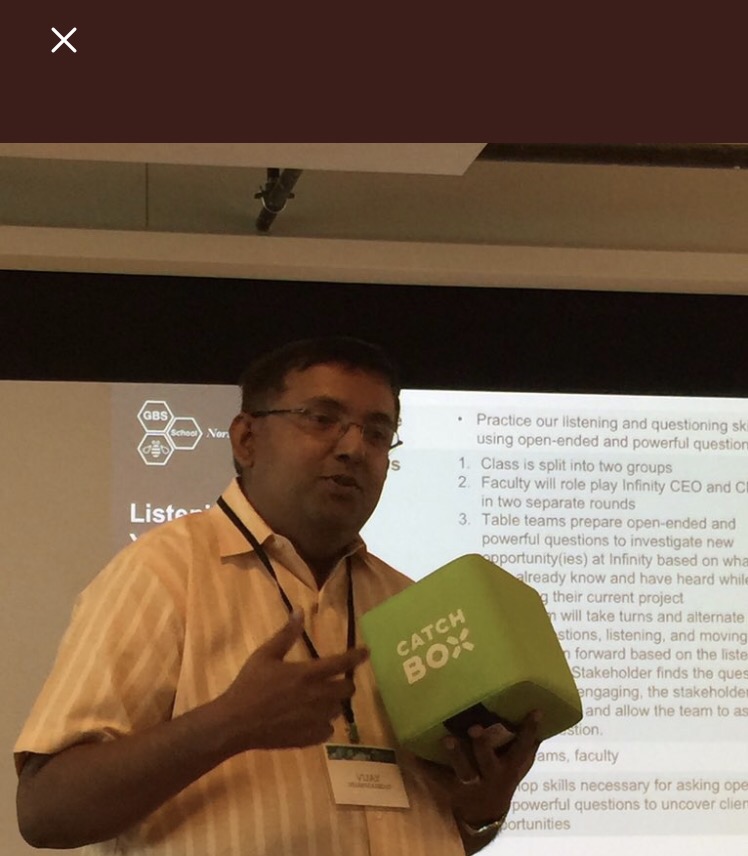
My favorite part of these schools are the "ask me anything" sessions . When you can ask and answer hard and often uncomfortable questions, you start growing !
Last week at dinner, Lorraine told me "you are the Zen master of Bee school" given how I apparently had a calming influence during the chaotic times we went through in preparation . Well, if I was Zen – it's only because I had, and continue to have, full confidence in the amazing team around to me . And also along the way , I learned that it's foolish to stress about things you can't control 🙂
Success breeds success – and the confidence I got from being part of this team that put together Bee School led me to start a second learning initiative that I lovingly call the T-school which is where we focus on technology training , like AI and IOT . We ran the pilot couple of weeks ago and it was a lot of fun hacking AI solutions with 30 of our new engineers . And again – it only happened because we brought together a team that was super passionate about the cause and leaders from the business took time out of their day job and came in as teachers. I lucked out having a great partner in Andreana Miller from our learning team and a bunch of new friends from our global team .
And in the process, the Bee school got a fantastic upgrade too . Susan Wedge , a dear friend and a great leader of our public sector business , took over Bee school sponsor role from me . I can't wait to see her take it to even greater heights !

Not only was the investment in learning good for my soul and fun for all of us – it had some side benefits too in my day job . I now have a MUCH better appreciation of what great looks like and how iteration is far superior to aiming for upfront perfection . And best of all – there are now several new ideas for making our clients more successful . It's just fascinating watching what happens when high potential people are given the tools and freedom they need . Pure magic !
One last point before this plane lands in SFO – we all know that asking for help is a good thing . What I realized in the past few months is that asking for help should not be just to your senior management – a lot of help can and does come from your team as well . I can't tell you how cool it is to see my young engineers and consultants jump in and solve problems with high quality when I requested their support . And their energy is infectious – and has convinced me beyond a shred of doubt that I have more help to ask 🙂


 And Vijay Says...