CES 2017 – Random Thoughts On Future of APIs In An AI world


I spent half this week at CES 2017 in Las Vegas !

15844324_10210319385955546_7881371335845216256_n

To say the least, it puts the “enterprise” side shows to shame in number of people it attracts, variety of solutions it offers and how boldly the future is thought about. It did not take any time to see that the future is all about AI – and how expansive the definition of AI has become.

There were bots of all flavors there – but voice was the major interaction media, and it was hard to walk the floor without hearing “hey Alexa” type conversations . Also noticed a lot of VR and AR. I walked away thinking voice will rule the consumer world for a while, and between VR and AR – I will bet on AR having more widespread use. While VR based video games are indeed cool – putting on something on your head to use technology makes me wonder how many will actually use it. Like 3D televisions – where you need special glasses, and hardly anyone uses it that I know.

The generation of products using AI that I saw (admittedly I only saw a small fraction of the HUGE show) barely scratched the surface of what is possible. If I think of what I saw with my engineering hat on , it is something like this

  1. Human voice or text waking up the AI service ( “hey Jane” )
  2. A natural language based request ( “When is my next meeting” )
  3. Voice to text translation as needed
  4. Intent and entity extraction ( me, my calendar, current time, read entry)
  5. Passing it to a structured API ( calendar.read ) and get a response
  6. Convert output to a string ( “your next meeting is in 2 hours with Joe” )
  7. Text to voice translation
  8. Keep the context for next question ( “is there a bridge number or should I call Joe’s cell?” )

This is easy stuff in general – there are plenty of APIs that do stuff, and many are RESTful. You can pass parameters and make them do stuff – like read calendar, switch a light on , or pay off a credit card. If you are a developer – all you need is imagination to make cool stuff happen. How fun is that !

Well – there are also some issues to take care of. Here are 5 things that I could think of in the 1 hour in the middle seat (also in the last row, next to the toilet) from Vegas back home.

Like say security – you might not want guests to voice control all devices in your house for example (which might not be the worst they can do, but you know…). Most of the gadgets I saw had very limited security features . It was also not clear in many cases on what happens to data security and privacy. A consistent privacy/security layer becomes all the more important in the AI driven world for all APIs. 

Then there is Natural language itself. NLP itself will get commoditized very quickly. Entity and intent extraction are not exactly trivial – but its largely a solvable problem and will continue to get better. The trouble is – APIs don’t take natural language as input – we still need to pass unstructured>structured>unstructured back and forth to make this work. That is not just elegant – and it is not efficient even when compute becomes negligibly cheap. Not sure how quickly it will happen, but I am betting on commonly used API’s should all have two ways of functioning in future – an NLP input for human interaction, and a binary input for machine to machine interaction (to avoid any needs to translate when two machines talk to each other) . Perhaps this might even be how the elusive API standardization will finally happen 🙂

If all – or most – APIs have an easy NLP interface, it also becomes easy to interoperate. For example – if I scream “I am hungry” to my fridge, it should be able to find all the APIs behind the scenes and give me some options and place an order and pay for it. And my car or microwave should be able to do the same as well and I should not have to hand code every possible combination . In future APIs should be able to use each other as needed and my entry point should not matter as much in getting the result I need. 

Human assistants get better with time. If an executive always flies by American Air, when she tells her assistant to book a flight, the assistant does not ask every time back “which airline do you prefer” or “should I book a car service also to take you to the meeting when you land”. The virtual assistants – or pretty much any conversational widget – I saw this week had any significant “learning” capability that was demonstrated. While I might enjoy having a smart device today since it is a big improvement from my normal devices – I will absolutely tire of it if it does not get smarter over time. My fridge should not just be able to order milk – it should learn from all the other smart fridges and take cues from other data like weather . In future, “learning” should be a standard functionality for all APIs – ideally unsupervised. 

The general trend I saw at CES was about “ordering” a machine to do something. No doubt that is cool. What I did not see – and where I think AI could really help – is in machines “servicing” humans and other machines. For example –  lets say I scream “I am hungry” to my fridge. The fridge has some food in it that I like and all I need is to put it in the oven. So fridge tells the oven to start pre-heating – and gets no response in return ! Telling me “the oven is dead” is a good start – But the intelligent fridge should be able to place a service order for the oven, as well as offer me an option to order a pizza to keep me alive for now. APIs should be able to diagnose ( and ideally self heal ) themselves and other APIs in future – as well as change orchestration when a standard workflow is disrupted. 


Future of Project Management 


Next to programming , Project management is the role that gave me the most satisfaction in my career. So after Rethinking IOT and AI for future , and Future Of Technology Consulting – I spent some time organizing my thoughts on where project management is today and where it is headed .

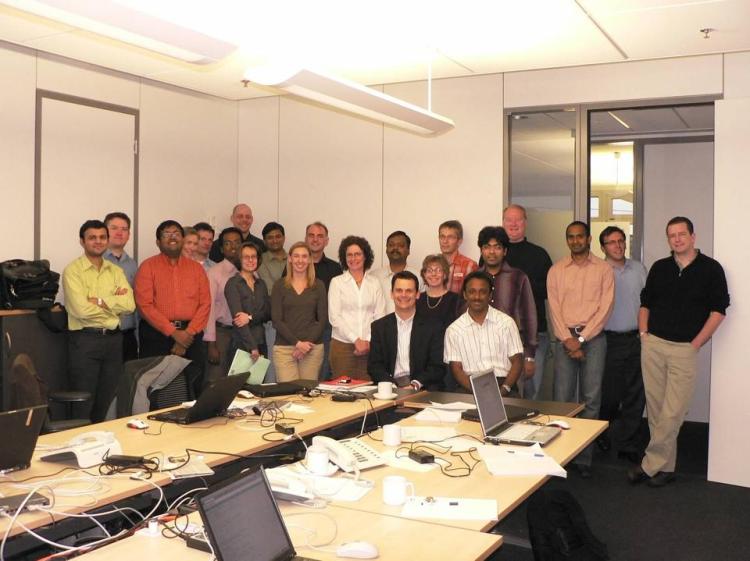
This picture is an old one – where I was leading a consulting team as the PM at my client, and we were codeveloping a product with SAP. There was no way to distinguish who worked for which company in this team. It was a highly stressful time – but also the most fun and productive time of my life 

team

In general I think project management as a profession has lost its stature and for all the wrong reasons . I also think that it will regain its lost glory, and then some, starting almost immediately !

Utterly stupid is how I would describe the move to commoditize project management over the last few years . The PC version would be penny smart, pound foolish !

Several factors played a part – and I think the wrong use of PMP certification is one big reason.  I am personally not a big fan of certifications in general. I (and others) have successfully managed hundreds of millions of dollars worth of projects successfully without a PMP a . When I was a full time PM (also when i was a developer) , none of my clients ever asked me if I was certified . In my view PMP and tech certifications are a definite plus for the job – but should not be a mandatory requirement .

PMP gives a false sense of security and accelerates the path to “if everyone has a PMP , they must be roughly equal in skills – so let’s choose the cheapest one for the job” . When I convinced my old boss many years ago that I don’t need a PMP – my defense was that we commonly knew at least ten people in their early twenties – who have never even been a team lead – pass PMP exam with flying colors, and neither one of us were confident enough to let them run a team !

To be perfectly clear : PMP itself is not to blame . I have studied the “body of knowledge”  closely and it’s pretty good . I encourage all PMs and aspiring PMs to study it . I am just strongly opposed to treating it as a way to falsely equate everyone who has it to be of same project management ability .

Becoming a PM is best done in an apprenticeship model . Project plan , documentation , chasing down tasks etc are good things, and you can learn it from books – but successful projects are mostly about making people successful  , not tasks successfully completed ! There is a big difference and a full appreciation of that only comes from watching and learning from folks who do it consistently well . However smart you are – you can’t learn it by studying a book or taking a multiple choice exam .

Sadly – and probably due to the mandate to commoditize all parts of IT projects  , task management – which was a means to an end in the past – seems to have become all of project management today !

Consistency and repeatability and scalability are all good for efficiency . So dumbing down of some project management aspects have that aspect going for it . But what is missed out today is effectiveness – efficiency without effectiveness leads to failed projects . And effectiveness is all about people !

People have only so much intellectual and emotional capacity and not all of it is spent on work . Example – the best programmer in my team in Bangalore spent 4 hours every day on commute . Even then he was twice as good as the next programmer . I let him work Mondays and Fridays from home and he became three times as good at what he did . I knew that issue because I went to Bangalore and lived there for a month to see the team and work with them and become one of them . I couldn’t get the same result by asking him to document more or sit in more status calls . I also remember a situation where we had an unreasonable client who made constant demands of our time to meet time lines that were not realistic . After two weekends back to back at work – my team had no energy left . My solution was to stop working weekends and instead we all went out bowling for a whole day on Monday and followed by a potluck on Tuesday . Even the client could not believe we hit the deadline with room to spare !

Motivating and getting the best out of your team is one aspect – equally important is making your client successful . By that I don’t mean the client company – I mean the human beings from the client team who work with you and sponsor the project . This means you need to get to know them , what makes them tick and what success means to them. No certification teaches you empathy !

To make clients successful – you need to know their business and their industry cold , or know others whom you can tap into for that knowledge . You also need the ability to make short term vs long term trade offs .  I once had a finance director of a company as my client – and she was stressed out that there wasn’t enough time left to build 150 reports that were scoped for the project . I worked with her and told her similar projects in past only needed 50 or so reports for similar functionality and the two of us spent a day looking through the specs and quickly brought it down to 40 reports . My employer had a short term revenue loss because of reduction in scope – but this lady was publicly recognized by the CFO of the company for getting the project done on time and under budget . And she got a larger portfolio and I got a lot more business from her , which in turn helped my own career progression .

Project managers need the respect of their team to succeed. PMs who manage a project where they don’t know any aspect of what is being done generally find it harder to get the team’s respect. It can be done – but it is an uphill task and you need superior skills and patience. This is another reason why commoditizing PM skills is a terrible idea – people who grew into PM after being developers, consultants, team leads etc can empathize and add quality to their team’s work much better than someone who can only manage tasks.

Why do I think this will change quickly, and for the better ? Its because the complexity of projects and client expectations have both risen to a level where commodity skills and elementary automation cannot keep up. Fear of failure is very high today thanks to a lot of failed projects in past – and at the speed at which technology is progressing, there are very few “apples to apples” references to say “this will work”. Good solid project management is the need of the day to help realize the value of technology innovation happening around us. I think employers and clients are both ready – or very close to being ready – in treating PM again as a critical role in making projects successful .

Those of you who manage development teams as PMs might enjoy this post this post I wrote in 2010 🙂

PS : Might as well add a shameless plug – If you have experience as a PM in big data, analytics, IOT etc – I am hiring in North America. Ping me !


Future Of Technology Consulting


Its the last week of the year – and that gives me the luxury of time to spend thinking of some big picture topics. Last week I was Rethinking IOT and AI for future . And that led me to think of my own profession of technology consulting in future. Especially important to me since my 11 year old daughter wants to be in this profession when she grows up . She wrote this in her first grade journal – so it is official 🙂

IMG_5961

As always – these are just my personal points of view and do not represent the views of my employer.

Tech consulting is bound to get disrupted at least twice in my remaining professional life – with pendulum swinging first in the direction of flexibility, and then in the direction of convenience. That means the big and small companies that play in this ecosystems, and the assorted consultants that work in these companies are in for some crazy times. I would venture a guess that the first wave will be within 3 to 5 years, and the second one probably 7-10 years out from now.

When I joined consulting, the career option was pretty straight forward. If you were good at what you did , you can make Partner in about 10 to 15 years and then reap the benefits of that till you retire and then retire on a comfortable pension. Billing rates of $500 to $800 an hour did not raise many eye brows in those days. Well – that has changed for sure over my professional life !

When I hire new college grads these days, I see only a minority who have a career plan of sticking it out at a consulting firm for 10-15 years to make partner. Most of them plan to keep their options open to explore other careers along the way. When I hire for experienced roles – I increasingly see candidates who are from non consulting backgrounds wanting to try consulting for the first time. I also saw the reverse of this when I was in the software business for few years – many consultants (like me) wanted to gain exposure to software business. I am not a career channel management executive – but I had a great time establishing a channels business at MongoDB. In short – traditional career paths are dying and more and more people at all levels of their profession are vying for flexibility .

Interestingly – while employees have made the change in large part to this “flexibility first” mode, most employers are still in “traditional” mode. I believe the inherent difficulty for larger companies is how the financial market looks at them – risk taking is encouraged for small companies, and punished at larger companies. And changing the org model is fraught with short term risk by definition – so employers resist change in many ways. The more progressive ones encourage flexibility in hybrid models – take one day a week to do your own projects, put a consulting guy in charge of channels team, take a line sales leader out of the business and put her in charge of HR etc. They try to “force fit” employees with “new” ideas into “traditional” career paths. It does not seem to scale very well from my (admittedly limited) perspective.

At the moment, number of employees with such career attitude is not large enough – but in 3 to 5 years, I expect it to overwhelm and overpower organizations that a new paradigm will need to be built. And when overwhelming force is applied to organizations with a lot of inertia, the pendulum swings to an extreme. My bet will be that technology consulting firms will become master orchestrators that bring a tailored collection of skills to a client – even though majority don’t work for them directly. But this model has one inherent problem – elasticity is not your friend in labor based business.

So that means – tech consulting companies will need to shift their business model to be more of an IP based one. That needs new skills that historically were not important to these firms – like engineering, product management and product marketing at scale. A lot of existing roles will probably go into a “freelancer” system. Another way of saying it is – there will not be much difference from what is a product and what is a service. These lines will all get very fuzzy . A natural side effect will be acquisitions of product companies by tech consulting companies – at scale, unlike the handful that happens today !

The disruption this causes will be tremendous. Procurement function will need new ways of evaluating suppliers . Analysts and VCs/PEs will need new ways of assessing value of businesses. HR will need new ways of sourcing and developing talent. And so on . I won’t name names – but I have a list of tech consulting companies in mind that probably cannot deal with this and will end up in utter chaos at a minimum, or go out of business at worst. Yeah, I think it will be that dramatic (and I hate drama at work).

What happens next ? The way we deal with such chaos is usually to swing the pendulum in opposite direction. About couple of years into the chaos caused by this disruption – I totally expect leading companies to realize that for scale, some centralization is a must. Its like mainframes to client server to cloud to edge computing – centralization and decentralization happens back to back at intervals to keep the universe in balance. I don’t think the asset based nature of business itself will go away – but I do think the employees and employers will realize the pragmatic limits of autonomy and flexibility and make compromises.

But that still leaves the wild card – the power of automation to disrupt the disrupters. In this 10 years or so that I painted above – there is no saying how quickly automation can influence tech consulting’s business models fundamentally. The incremental changes are already well known – but as with every long term disruptive force, I would bet on us having under estimated the effect it has on our future.