Incredibly Inspiring India !


About 5 months ago, I took a new role in IBM as the Senior Partner for IBM services for our relationship with American Express. Since then, I have been busy getting to know the leadership team at my client , as well as my own team in AZ, NY and FL . The relationship between our two companies is 105 years old and thriving !

After being on the saddle for my first full quarter, the next logical step was to visit the Amex leadership team in India, as well as my own team spread across Bangalore , Delhi , Pune and Kolkata . So I jumped on a plane and headed east.

Qatar Airways rocks

I have flown almost every imaginable combo of airlines to get to India in my life . After a couple of million air miles, I have very little joy left for flying. But Qatar showed me that flying can still be fun. Comfort , safety , food , service, timeliness , beautiful lounge – there is nothing I could ask more of . How I wish American Airways learned all this from Qatar !

On the domestic front in India, I flew Jet airways , Air India and Indigo . Jet was amazing and came very close to Qatar . Air India surprisingly wasn’t too bad like my past experience. Indigo – the only good thing I can say about them is that they were on time.

I saw what digital transformation at scale looks like

One of the biggest problems flying in to India used to be the long immigration and customs lines in the airports and multiple forms to fill . And this time – there were no forms to fill and from flight to picking up my bag from baggage claim to getting into the cab (which I booked in the prepaid counter on my way out) barely took 10 minutes . The whole experience was smooth and frictionless – and the cabbies generally use google maps on their smart phones to find their way . Cabbies also take mobile payments !

The domestic checkin process still has room for improvement – especially in the older airports like Pune . Delhi , Bangalore and Kolkata etc are all quite impressive airports and of international standards.

Lot of faces from the past !

In every city I visited, there were old friends to catchup . I hadn’t met many of them for as long as 25 years in some cases ! It was tiring to take 15 flights in 10 days – but these reunions totally made up for it.

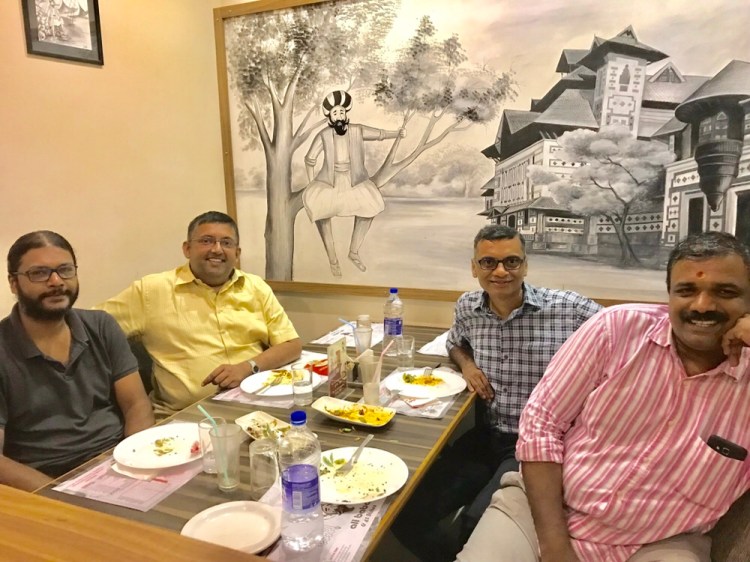
Nandu and Rajesh – both live in US – and we hadn’t met in 22 years and finally caught up over hot filter coffee 🙂

My engineering college class mates Vinod ( he is a real rocket scientist) , Regin and Renjith ( Both entrepreneurs)

My dear friend from high school Sojan, who lives in Netherlands, but happened to be visiting his folks in India . Only took 20 years for this reunion 🙂

Nikhil , with whom I worked shoulder to shoulder on SAP projects – including a particularly great one in Dresden. Almost ten years since we last met in San Jose

There are five of us from the same engineering class in IBM . Hemant is one – and was so great to run into him in our Pune office

I had recruited Vikas to our SAP team in 2002 . Our families were very close and were neighbors. Pure serendipity that let us meet in Pune since he had just moved there from UK

This young lady Amrita – my wife’s young cousin – was a little girl when I last met her , which was on my wedding day . I still can’t think she is all grown up now and a busy professional

No trip to Bangalore is complete without a beer with my two buddies Maheshan and Arvind . They were my most trusted colleagues in one of the best teams I had the honor to lead and we have been friends for more than ten years. I still remember the day I recruited Arvind from SAP Labs to IBM 🙂

And thanks to Ajith, a number of our engineering college class mates had a mini reunion in Bangalore in a pub . It was amazing to catchup with each other after a couple of decades

Indian IT services are evolving fast

Indian IT services scene grew into its current status based on two things – the factory model that FC Kohli and TCS team started , and cost arbitrage with other high cost geographies. Those days are over – now what I see here is that two other dimensions are where India differentiates . One is talent and the other is intellectual property . This is heartening for me to see – and seriously makes me think of taking a tour of duty to work in India for a few years .

On the flip side – the growth of IT services in the big metros is not sustainable. It can take two hours to travel 5KM in Bangalore for example . We need to solve this quickly !

My gang !

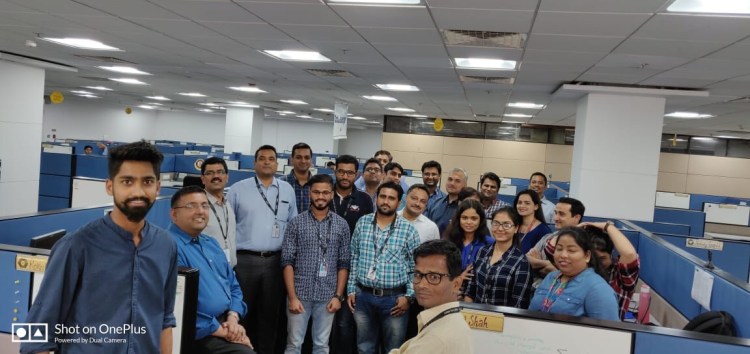
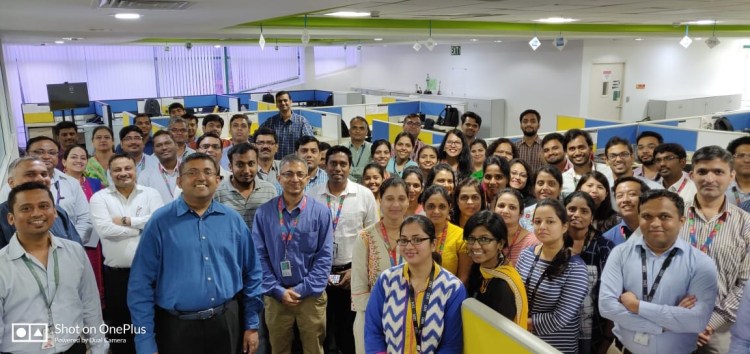
I couldn’t be more thrilled ! Super smart peeps – and so dedicated to making our client successful . Several of them have spent 15+ years serving the same client and know their business cold .

Plenty of IP is being generated from our India team and the highlight of the trip was to geek out with them on ML , Cloud native development and so on . Not only is the IP great – it’s amazing to see how much importance is given to immersive experiences in the client centers . Absolutely world class

Diversity

One thing that captured my attention quickly in this trip is the number of women in the workforce . I think at entry level – perhaps more than half the incoming employees are women .

I spoke with several colleagues about this and generally got the impression that while there is definitely some women who drop off the tech field when they start a family , there are still more women who build a career in technology compared to what we typically see in US . I first hand know several senior women leaders in IBM India as well as in Amex India . I did hear that the ratio is not as even outside the big metros – but definitely got the impression that India is on the right side of diversity and inclusion in tech and that is awesome !

Guests are still Gods in India !

A core tenet of Indian philosophy is “Aditi Devo Bhava” which translates to “guests are Gods” .

I had a traditional Kerala Sadya at a restaurant on the last day of this trip . The lady who served me called me son , and she nearly was in tears when I told her I can’t have four types of payasam . My cab driver in Kolkata called me and woke me up at 2.45 AM for a 4.40 AM flight because he felt it’s his duty that I have a stress free experience while I was his client . The chef in the hotel in Pune sent me filter coffee when he heard me speak Tamil on phone – and I didn’t have the heart to tell him I am from Kerala and not Tamilnadu 🙂 . The list goes on and on .

That’s a level of customer service I don’t often see elsewhere as I trot around the globe . It has completely changed my view on what world class customer service feels like. And to think this happened in the analog world without customer surveys !

I am leaving back to US with my heart full of gratitude – and I will be back !

It’s time to re-think life time appointment of Supreme Court Judges !


The whole drama around the process of confirmation of Kavanaugh as a judge in the SCOTUS is a wake up call for the citizens of USA to address the underlying problem – the life time appointments of judges to the highest court. I want to share a few of my thoughts on this topic

blur close up focus gavel
Photo by Pixabay on Pexels.com

Does life time appointment make judges impartial and reduce pressure on them ?

I think our reflex is to say “of course, it does”. I don’t think that is true actually. Life time tenure gives them job security and prestige obviously, but their fundamental political and economic leanings do stay with them as we have seen from predictable judgements time and again. As long as they know exactly how long they have the job – there is no reason why they should feel extra pressure to make impartial decisions in their tenure.

USA is probably the only democracy with this issue

As far as I can find out, there is either a mandatory retirement age or a term limit for judges in the highest courts of other countries. Some countries seem to have a combination of both . If you know of exceptions, I will gladly stand corrected. But if we are unique like I think we are – at least we can look at countries who have solved this problem in the past and get some ideas. It may be interesting to note that Thomas Jefferson was against the idea of life time appointments . And as far as I can find out – Rhode Island is the only state in this country that allows life time tenure for their judges. Should that not make us sit up and think harder about the federal system ?

Age – both too young and too old – is a real problem

When it comes to being the highest court, age comes as a problem in two flavors. Presidents like young judges because their party’s interests will be taken care for a very long time. Too young judges being appointed unfortunately means that judges with more to offer than the young ones get overlooked all the time strictly because of age. The second flavor of the problem is that we no longer know if the very old judges have the ability to make high quality decisions, or whether they are just the face of what their law clerks decide. With medical science improving – the chance of longer life of judges is the trend we should bet on. There is a reason why most professions have a retirement age !

Unhealthy confirmations need to be avoided 

SCOTUS is too important in a democratic setup to have judge appointments turned into political drama. But since the confirmations only come at random points – both parties have all the incentive to push for extremes. Also, it is impossible to plan adequately for the next judge if we don’t know when the next vacancy will come. Should we not develop the top legal talent in a planned way for this top job, as opposed to rush through the process in short order ?

There are several implementation issues to work through

There is practically no way to make any overnight changes – any change will need to be phased in over a long period of time. For the younger judges, there will be always a question of what can they do after retirement. Pension plans will need to be revisited. There needs to be a debate on how long should the tenure be – but if we go by history, it converges naturally around 15-18 years on average. We will need a constitutional amendment probably to get this done – but that is not something we have shied away from in the past. 22nd Amendment to limit Presidents to serve only two terms is a good example – and that was in 1951.

An honor system could work just fine too 

Before FDR, Presidents just left office by themselves after 8 years by themselves (or nudged to do so). Our judges could follow such an honor code too – that they just choose to leave the bench after a certain number of years, say 15. That would be an awesome precedent to set – and will probably make it a lot less frictionless process than a constitutional amendment. The 22nd Amendment was passed by Congress in 1947 – but it took till 1951 to get states to ratify it. All of that can be avoided if the current Supreme Court judges set a great example themselves.

Finding time


If there is one sentence I have heard the most as an excuse in my career, it would be “I didn’t have the time to get to it”. This would be totally fine if it came from someone who had to do multiple jobs to take care of their family, or something along similar lines. But no – I am talking about people with one job that pays reasonably well. They are truly sorry about it most of the time too – they wanted it done and perhaps even wanted to do more tasks than the one they are referring to at the moment. Corporate world is full of them – and I was one of them .

To add to their woes – since they can’t find time to do everything on their plate, then they start worrying that this is detrimental to their family life, their career progression and general sanity . All of which may be true too in many cases.

Heroics do get rewarded in the corporate world – some of these folks get promoted to senior roles and the time crunch becomes even more acute for them. Eventually some find the way out of this , and unfortunately several just burn out or at least hit their Peter principle limits.

I want to share some thoughts on how to find the time that appears so elusive

I work under two constraints – 1. Big and small decisions both tax the brain 2. Brain only has finite capacity to make quality decisions

Picking the right shoes to wear, deciding what to order at Starbucks, deciding who to promote in your team, deciding how to message bad news to your client – these are all decisions that we need to make, sometimes on the same day. And we need some reserve capacity to deal with the inevitable surprises ( like Starbucks is out of green tea , your favorite promotion candidate has taken another job at your competitor ) that need quick thinking.

So the way I approach this is to minimize new decisions I need to make. Have a process with default values for routine decision making (For me – If I have a standard simple order for Starbucks , and a go to pair of shoes ).

Next, I tier decisions into A,B,C .

A level problems – the ones that move he needle, and ones I am uniquely qualified to solve – needs high quality thinking . These are like deciding on the next promotion candidate, or what school to enroll your kid . That needs focus without distraction , and probably a lot of data collection when time permits. Thankfully this is the minority of all decisions you need to take . So all the surplus thinking/doing capacity you make by having good strategies on B and C can be used for A.

B level problems are ones you can take the help of someone else to decide, and your value add is in quality assurance . The solutions are not unique, and are minor variations of things we already know how to do. In my world, a routine proposal response doesn’t need my time to draft – that can be delegated to my team. My value add is in the review process and providing guard rails.

For this to work – What is a B decision for me must be an A decision for who I delegate to . If it’s a B problem for me , and it’s a B problem for the team I pass it on to – then it will just keep getting delegated till someone who looks at it as an A problem gets it. When this happens – the right question to ask and solve for is why I was the one to be asked to solve it in the first place.

Then there are the C decisions – low risk and low reward types. Here I run on autopilot as my default option. If the Starbucks line is long, I am happy to get a Diet Coke from a vending machine and move on. But if I can’t find anything at all – I am happy to move on with no beverage too. FYI emails that have no explicit request for you to act is a C problem. Ignore it (or glance at it ) and move on .

Know your available time so that you can optimize it . For me – that means I decide upfront all the personal activities I won’t compromise on like picking my kiddo from school when I am not traveling, sleeping 7-8 hours every day, tending to my garden on weekends , reading a book etc . Those are explicitly marked as blocked time on my calendar . So I know exactly how much time I have left to tackle the problems I know of . I also block some time every day for potential A level problems . If none seem to appear by previous night, I will release the block to do something else.

Convert as many A problems to B problems to give yourself even more capacity . It’s an A problem because you are uniquely qualified to solve it. Start involving your team in those decisions so that they know how to do it too and then you can make it a B problem for you and an A problem for them. When most of your erstwhile A problems become B problems, and your boss agrees that is the case – then you are ready for your next role!

In your quest to optimize your life and career, please don’t overlook what’s on your team’s plate. If you delegate more than they have skills and capacity for – you still have the same problem as before , but now instead of just your boss hating you – your team hates you too 🙂

Control what gets into your plate . Since in most cases we can’t choose who our bosses are – it’s not unusual to get a lot more work than we can reasonably do with quality. Over time – and it takes significant time and effort – you need to cultivate the ability to say NO to things you know clearly that you can’t add value to.

A few things that have worked well for me here

1. Give my boss clear visibility on what my team is capable of . So some jobs that come to you , can go to your team instead without the boss thinking you are delegating mindlessly

2. Do an extraordinary job of A level problems so that you accumulate goodwill that can be used for when you say NO

3. Have absolute mastery over routine blocking and tackling so that it does not appear that you are spending a lot of non value adding time . Use delegation , automation, default values etc to your advantage

4. When unforeseen priority comes up – give a quick heads up to the boss on what you are reprioritizing. This gives a chance for the boss to rearrange it for you and have clear expectations on the trade off.

What do you do with all the extra capacity you hopefully created ?

1. Spend it on making more A problems converted to B problems and eventually C problems

2. Sleep more . Take your significant other out for something fun . Go for a walk with your puppy . Meet people . Unplug from the digital world. Give your brain a break

3. Learn something new . Teach something you know

4. When you are ready – and only then, take on the next A level problem new into your plate !

Parting shot

Even with all the best strategies and intentions, not every day and week will feel the same about having time. So you need to be ready for the unknowns life throws at you. But if 80% of the time you have a structure to solve the problems – you hopefully have enough capacity left in your brain to tackle the 20% that comes from left field .