Story telling for techies


The first time I saw bottled water being sold at the TRIVANDRUM Central railway station, I remember it being a big joke in my family . We continued taking water from home when we travelled for a couple more years, constantly making fun of those “Bisleri” vendors, and the idiot travelers who could have just brought water with them like we did . And then, my family too made the switch to bottled water and no one reminded us that the joke was on us now πŸ™‚

A similar story is going on in companies too – there are now official titles of “Chief Story Teller” in many places. The first time I met a story teller in flesh and blood – she knew in a second that I didn’t take her role seriously. She didn’t defend her role or anything – instead she started humming “Do you believe in magic” and we both burst out laughing.

Pretty soon I became a believer – I started seeing the effectiveness of story telling in sales scenarios . When dry PowerPoint presentations were replaced or augmented with good crisp stories – we started winning more business. I became a big fan in quick time – and also realized that the only way to scale this is if all of us became good story tellers – instead of relying on one story teller for the whole team for everything .

Once they see something that helps them sell – the people with sales quotas don’t need any more motivation to take it up. But engineers don’t work that way and I should have known . I started hearing things like “I am a DBA – what fluffy story do you want me to tell?” . For a little while I could get away with “Well, I am an engineer too and if it works for me it works for you too”. Pretty soon – and of course quite expectedly – my defenses were met with “Yeah, but you are not much of a real engineer anymore”.

So is there any good reason for techies to gain some experience in story telling ?

To answer that, we don’t really need to dig very deep. The biggest frustrations of technologists is usually that people who need to make important decisions that affect us – like approving budgets, resource allocations, Infrastructure purchases , hiring … those folks are usually not techies and never seem to understand the gravity of what we tell them . It’s almost as if we don’t even speak the same language πŸ™‚

The frustration is quite real. The very first time I had any alcohol was when my boss came to my apartment with two bottles of wine to get over our grief about the client PM not agreeing to upgrade the test server we were working on, despite we taking turns to walk him through twenty pages of performance statistics . I also got introduced to some of the most colorful German phrases that evening πŸ™‚

Good stories are well engineered and have great structure and flow. All the more reason that engineers should find it easy to tell great stories.

All stories have a simple design pattern –

1. There is an intro, to set the context

Engineers are finding it hard to get approvals for essential stuff like more cloud capacity, better brands of beer in the fridge etc .

2. There is a conflict, since there are choices to make

An alarming number of engineers are ordering cheap wine online and getting it delivered to office, and coming up with rude names for the project managers and the CFO. Monthly outages have been replaced by weekly outages even though everyone is working weekends. Customers are saying things are not working as advertised . And yet everything magically looks fine on the CFO spreadsheets and the board deck !

3. There is a resolution or revelation

Engineering VP shares his cheap wine with John in marketing who tells him they have surplus CMO budget for the quarter. They convince the CFO to use it for buying more cloud capacity . CFO buys expensive wine to celebrate problem resolution . They live happily ever after !

That’s pretty much it ! Give it a try – After all, we are people who made the switch from waterfall to agile and lived to tell the tale . Story telling should be an absolute piece of cake for us.
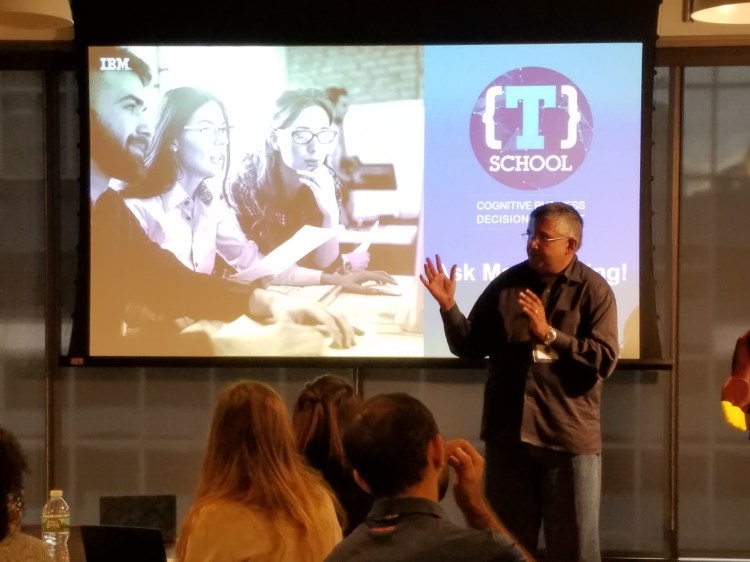

Making your point !


One of the most embarrassing professional development moments for me was a class on communication that I took as a trainee in TCS in 1999. The instructor video taped me – and went through the replay, pointing out everything that went wrong with my short presentation, in excruciating detail. He concluded with “If you don’t change all these, You will never make your point effectively, Vijay !”. For the next 5 years or so – every single one of performance appraisals had a line “Should work on improving communication skills” πŸ™‚ .

20171023_101326

While I don’t claim to be a master communicator by any stretch of imagination, I have largely succeeded in making my point most of the time. It took me a few years to get there, and hopefully I can save you some time by sharing what I learned. “How do I improve my communication skills?” is also one of the questions I get asked a lot – especially by people who grew up in India like I did, and then chose to live and work abroad.

Here is my simple 3 step approach to making my point.

  1. What-Why-How :Β I try to organize my talk track by defining the problem, explaining why this is the right problem to be solved , and my thoughts on next steps.
  2. Reinforce :Β Each step above needs some validation for your audience to buy in. This could come in many different forms – modulation of your voice, dramatic silent pauses, rhetoric, data, stories, pictures etc. This is the part where practice and experience makes you better.
  3. Repeat :Β We over-estimate how fast people understand what we are saying. It is more efficient to just repeat your key points. This is especially important when the talk is interactive – its very easy to misunderstand, or just lose track when there are objections, or a lengthy debate on some part of what you said, or just a mean remark. In such cases – paraphrasing is usually one of your best friends. It helps clarify the intent so that you can respond effectively, and has the side benefit that people generally like their own words repeated to them πŸ™‚

Once you do this a few times, it will become second nature and you won’t need to explicitly think of the three steps. And – it works just as well outside your work too.

Couple of things to keep in mind

  1. Less is more – You don’t need to say a lot to make your points. Dr King’s highly impactful “I have a dream” speech only lasted 17 minutes. President Lincoln’s Gettysburg Address only had 272 words. Bohemian Rhapsody only has 361 words in its lyrics.
  2. Simple words are all you need –Β Your primary intention is to be well understood. Even when addressing people who know all the fancy words, your ability to explain in simple language will usually help increase their confidence in you.
  3. Don’t worry about your accentΒ – This took me a while to appreciate. As a non-native speaker of English, I constantly worry about my thick Indian accent standing the way of people understanding me. In my case, it was mostly the speed that was the actual problem – and I learned to slow down, and people understood me better. When people hear a foreign accent – they tend to listen with more attention, at least to begin with. They also forgive some mistakes in grammar.

Happy new year !


Conquering the three big fears in enterprise sales


I can’t believe that 2018 is nearly over ! I have been checking in one folks that I mentor for the last couple of weeks to see how well everyone is doing before we all head for vacation time. Those with a sales quota that hasn’t been retired generally are on an overdrive of emotions in December – positive or negative.

Even for experienced sellers – occasionally, fear of not retiring their quota becomes a paralyzing issue . For inexperienced ones – I have noticed it to be fairly routine. I thought I will share my thoughts on this topic here

There are three big fears to overcome in enterpise sales

1. Fear of inertia

This has two flavors to this – external and internal .

Most customers hate change unless they are sitting on a burning platform. It’s not enough that you think there is value in what you are selling – you need to validate (and sometimes repeatedly) with the customer first hand that they see the value in moving to your solution.

The internal flavor can cause just as much anxiety – especially in larger companies with complex and rigid approval workflows . I have fallen victim to this when I started out – I was more afraid of our internal finance and ops reviews than about negotiating with actual client. That fear went away thanks to a mentor showing me that no reviewer knows my deal as well as I do and that if I can confidently explain it , the inspection session can be turned into a coaching session . As I gained experience – it also helped me challenge some processes and get them changed

2. Fear of competition

From my own experience as a young seller many years ago, and then later as a leader of sellers – I have data to prove that the biggest threat to your proposal not getting ink on paper is customer inaction, and not competition . Ergo – the lack of thoughtfulness in crafting your value prop , and lack of customer relationship are way more serious threats to your success than your competition . Those are both within your control to get better at !

There is one thing I insist with my team all the time – ALWAYS respect your competition , but NEVER fear them . If you don’t respect them – you just are increasing your blind spots and you won’t know what hit you. If you fear them – you will focus more on their strengths and weaknesses and not yours .

Price is a big reason why people worry about competition. A larger competitor might be able to offer a lower price than you could . Even the client might tell you that they are just looking for the lowest price . However – that doesn’t mean you will win if you have the lowest price ! There are always more parameters to differentiate and it’s your loss if you become one dimensional and fight the price war and race to the bottom. The one who wins is the one who understands the customer the most , not the one who understands competition the most !

3. Fear of the clock

Especially in December – this is the primary fear for most sellers . Will I be able to close this deal before end of the year ? Even if customer sees value and has recognized that you have a better proposal than others – they still may not choose to buy immediately.

This happens commonly when your value prop doesn’t account for the time dimension at all. If you only realize this late – you can still get a deal done by creating incentives like discounts , or asking for a favor with the relationships you have hopefully built . But those are all suboptimal in general for you and the customer . The better way to do it is to understand what is the most logical time for the customer to do the deal and then consciously (without time pressure) determine a good way to accelerate the deal closure .

Conquering the three fears

It’s absolutely possible to overcome these fears . I suggest the following as a starting point

1. Spend your energy qualifying your deals every step of the way from the moment you identify them .

2. Invest in understanding your client, your competition and your internal organization – in that order

3. Remember it’s a team sport ! Your manager and a lot of other people have a vested interest in your success – the sooner you make use of help available, the better your odds of success . Heroics should be a last resort , not your leading card

4. Never lose perspective of business cycles and luck . If 80% of deals work as planned – you should be happy

5. Never burn bridges – enterprise is a small market and you will see the same people again . The most difficult CXO I ever sold to bought from me at three different companies – and I was within an inch of yelling at him for what he did the first time I met him πŸ™‚

6. Never lose your moral compass. There is more to life than any one deal !